
Reviewed · LEMOSHO ROUTE CLIMBS
8 Days Lemosho Route Kilimanjaro Trekking
The Lemosho Route gives you Kilimanjaro in chapters: rainforest first, then the broad Shira Plateau, volcanic ridges, the Barranco Wall, and a cold, rocky push to Uhuru Peak. It is one of the prettiest ways up the mountain, with fewer people during its early days before joining the busier southern circuit.
I like the eight-day schedule, which gives your body more time to adjust to altitude, and I like the local setup led by Erastus, with guides such as Oliver and John handling the mountain work. The main drawback is the summit day: you wake around 11:30 p.m., climb for hours over scree, reach the crater rim near sunrise, and then descend a long way in the same day.
Key points to know before booking
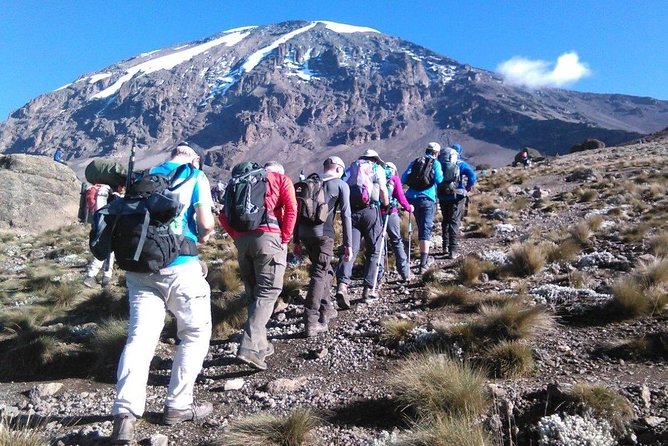
- A gradual route through five habitats: Rainforest, moorland, semi-desert, alpine desert, and summit scree give this climb a fine variety of scenery.
- An eight-day acclimatization plan: The long day through Lava Tower to Barranco is designed to help your body adjust before the summit attempt.
- A private group with a local operator: Mafie Adventures organizes the trek, with direct communication through owner Erastus.
- A demanding summit day: You climb from Barafu Camp at about 4,550 meters to Uhuru Peak at 5,895 meters, then descend to Mweka.
- A strong package of included costs: Park fees, rescue fees, camping equipment, meals, porters, taxes, and mountain accommodation are covered.
- Extra costs still matter: You need to budget for flights, lodging before and after the climb, rental gear, sleeping bag, insurance, visa fees, and tips.
Why Lemosho is worth the extra days
Kilimanjaro is not a technical climb in the mountaineering sense, but it is a serious high-altitude trek. The key challenge is not simply distance. It is how your body responds as you move above 4,000 meters.
That is where this eight-day route makes sense. You are not rushing straight toward the summit. You spend several days rising through different mountain zones, then use the Lava Tower and Barranco section to sleep lower than your highest point of the day. This climb high, sleep lower pattern is useful for acclimatization.
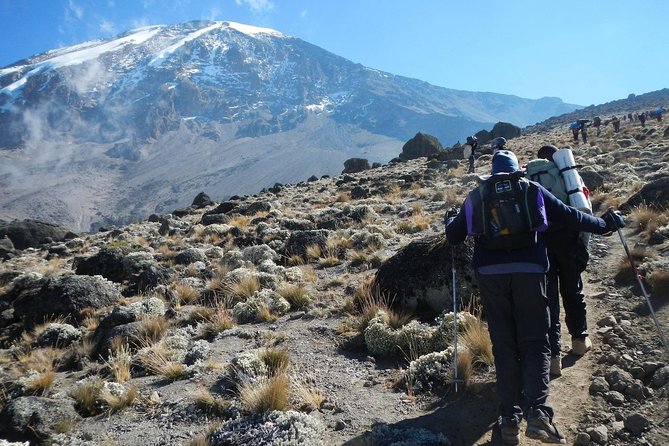
The route also has a fine visual rhythm. The first day feels enclosed and green. The second opens into heather and volcanic rock. Days three and four give you wide views across the Shira Plateau and toward Kibo, Kilimanjaro’s main summit. Later, the mountain becomes bare, gray, windy, and stark.
Crowds are usually lighter on the early Lemosho section because the route begins on the western side of the mountain. Once it joins the Machame route, you share parts of the southern circuit with other groups. That trade-off is worthwhile if you want scenery and a more gradual start.
More Lemosho Route climbs:
- Kilimanjaro climb by Lemosho Route (7-day)
★ 5.0 · 651 reviews - 8-Day Small-group Lemosho Kilimanjaro Summit Trekking
★ 5.0 · 186 reviews - Kilimanjaro Climbing Lemosho Route 8 Days.
★ 5.0 · 186 reviews
Day 1: Arusha to the Lemosho rainforest
Your morning begins with breakfast at your Arusha hotel and a guide briefing. Pickup is offered, and the planned start time is 6:00 a.m. From Arusha, at about 1,400 meters, the drive to Londorossi Park Gate takes roughly two hours.
At the gate, you complete entry formalities in the nearby village. Then you continue by vehicle for about another hour to the Lemosho trailhead. This transfer is not just a minor detail. It makes the first day longer on the clock, so be ready for a morning of driving before your boots hit the trail.
After lunch at the trailhead, you begin walking through undisturbed rainforest. The distance is about 6 kilometers, with three to four hours of hiking. Your first camp is reached through a cool, shaded habitat that feels far removed from Arusha.
This is a gentle introduction compared with the days ahead, but wet forest trails can still make footing slow. Keep your rain protection easy to reach. The route is quiet at this stage, which is one of Lemosho’s best features.
Day 2: Shira Ridge and the first wide views
Day two takes you out of the forest and into moorland. Tall grasses, heather, volcanic rock, and lichen replace the thick trees. The distance is about 8 kilometers, with around five to five and a half hours of walking.
You climb through rolling ground and cross several streams before reaching Shira Ridge. From there, the trail drops gently toward Shira 1 Camp. This is the first day when the mountain opens up in a big way, and you get a clear view of Kibo across the plateau.
The route is not especially long, but altitude begins to matter. You may find the pace slower than the distance suggests. Follow the guide’s steady rhythm rather than trying to hurry. On Kilimanjaro, a calm pace is more useful than an impressive one.
Day 3: Shira Plateau and Moir Hut
Day three is a longer walking day, about 15 kilometers and five to seven hours. You cross the Shira Plateau toward the glaciered summit of Kibo, passing through moorland meadows and continuing toward Shira 2 Camp.
The route then leads to Moir Hut, a less-used campsite at the base of the Lent Hills. Short walks on Lent Hills offer an acclimatization opportunity, although the day is already substantial. Shira is one of the highest plateaus on Earth, so the views are broad and the air noticeably thin.
This is one of the route’s special days. You get a sense of Kilimanjaro as a huge volcanic mountain rather than simply a summit to be reached. The open plateau also brings exposure to wind and weather, so warm layers should not be buried at the bottom of your bag.
More treks and hikes around Kilimanjaro:
- Kilimanjaro climb, Machame Route (7-day)
★ 5.0 · 262 reviews - Climbing Kilimanjaro – Machame Route
★ 5.0 · 170 reviews - Climbing Kilimanjaro through 7 days Machame Route
★ 5.0 · 151 reviews - Kilimanjaro climb, Lemosho Route (8-day)
★ 5.0 · 148 reviews
Day 4: Lava Tower, Arrow Glacier junction, and Barranco
Day four covers about 7 kilometers and takes around seven hours. From Moir Hut, you climb east along a ridge, pass a junction toward Kibo, and then turn southeast toward Lava Tower, also called the Shark’s Tooth.
The trail reaches about 16,000 feet at the Arrow Glacier junction before dropping to Barranco Hut at roughly 13,000 feet. Ending the day near your starting elevation may seem odd, but that is the point. You climb high, then descend to sleep lower, giving your body a valuable adjustment day.
This section is often physically demanding because of the altitude, even though the distance is short. Take it slowly, drink as directed by your crew, and do not judge the day by how quickly you move. Barranco is a dramatic camp, surrounded by steep volcanic walls and high mountain views.
Day 5: The Barranco Wall and Karanga Valley
After breakfast, you face the Barranco Wall. The route includes a Class 2 scramble, but it is described as easier than its first impression suggests. You will use your hands in places and move carefully, but this is not presented as a technical climbing pitch.
At the top, you get views toward Heim Glacier and may find yourself above the clouds. The trail then rises and falls through Karanga Valley before reaching Karanga Camp at about 3,950 meters.
The distance is only about 5 kilometers, with four to five hours of hiking. That shorter schedule matters because it gives you time to recover after the previous day and prepare for Barafu Camp. The campsite has washing available, but mountain washing is basic, so keep your expectations modest.
Day 6: Barafu Camp and the last water stop
Day six is another short day, about 4 kilometers and three to four hours. You climb toward Barafu Hut, where the trail meets the Mweka Route, the descent route used after the summit.
Barafu means ice in Swahili. The camp sits on an exposed, rocky ridge at about 4,550 meters. There is no accessible water at the camp, and this is the last water stop for the porters. That detail explains why the support team must carry water upward and why you should organize your personal supplies before arriving.
The tents are exposed to wind and rocks. Familiarize yourself with the campsite before dark, then eat an early dinner and rest. This is the quiet, awkward pause before the hardest day. Try to sleep, but do not worry if altitude and anticipation make that difficult. The schedule already accounts for a late-night start.
Day 7: Uhuru Peak and the long descent to Mweka
The summit attempt begins around 11:30 p.m., with tea and biscuits before departure. You climb through stone scree toward Stella Point, at about 5,685 meters. This is where the trek becomes most demanding mentally and physically.
The ascent to Stella Point takes roughly six hours. The reward is sunrise from the crater rim, assuming conditions cooperate. From there, you continue for about two more hours over a snow-covered trail to Uhuru Peak, at 5,895 meters.
The summit section is not a quick photo stop. You are already tired at Stella Point, and the final push comes at extreme altitude. Move slowly, follow your guide, and keep your expectations realistic. Reaching Stella Point earns a green certificate, while reaching Uhuru Peak earns a gold certificate.
After the summit, you descend approximately 23 kilometers to Mweka. The full day includes about eight hours to reach Uhuru Peak and another seven to eight hours down to Mweka. That is a punishing schedule, even though downhill walking can feel easier at first.
Your guide and support crew are especially important here. Oliver is identified as one of the main guides, while John is also part of the crew praised for making the climb work smoothly. The local arrangement gives you direct contact with the people managing the mountain rather than placing you behind a large international booking office.
Day 8: Forest descent, certificates, and the Mweka finish
After breakfast, the crew holds a celebration with dancing and singing on the mountain. This is also when tips are presented to the guide, assistant guides, chef or chefs, and porters.
You then descend through forest for about three hours to Mweka Gate, covering roughly 15 kilometers. At the gate, you sign your name to receive your completion certificate. The final transfer continues toward Mweka village, described as about one hour and 3 kilometers from the gate.
This last morning is practical as well as celebratory. Your certificate records whether you reached Stella Point or Uhuru Peak, and the descent marks the end of the mountain portion of the trip. The activity finishes back at the meeting point in Arusha, according to the supplied details.
What the $2,700.52 price covers
At $2,700.52 per person, the cost is not just a guiding fee. It includes camping equipment such as a mess tent, mattress, and cooking equipment. It also covers park fees, rescue fees, taxes, mountain accommodation, porters, a professional driver and guide, and meals.
Food is listed as seven dinners, seven breakfasts, and eight lunches. Lunch on the first day begins after you reach the trailhead, and the meal count suggests that food support continues throughout the mountain schedule.
The value comes from the number of costs bundled into a single price. Park and rescue fees alone can make a Kilimanjaro trek much more expensive than a standard multi-day hike. Porterage and cooking support also change the trip from a self-supported expedition into a guided climb with a full camp system.
You still need to pay for international flights, lodging before and after the trek, a sleeping bag, climbing gear, bath towels, insurance, visa fees, souvenirs, and tips. Climbing gear and sleeping bags are available for rent, which can reduce the amount you need to bring from home.
There is also a warning about government increases in taxes or park fees. Ask for the current total before you pay, and confirm exactly what is included in any rented equipment.
The people behind the mountain days
Mafie Adventures is a local Tanzanian company, and that matters if you value direct communication. Erastus, the owner and organizer, is described as easy to reach through email and WhatsApp and able to adjust trip arrangements, including last-minute changes.
Oliver is named as a main guide, and John is also connected with the crew. The strongest praise centers on friendly communication, organization, and the quality of the mountain team. That is important on Kilimanjaro because your guide is not simply showing you a path. The guide sets the pace, watches the group, manages the summit schedule, and coordinates the porters and camp routine.
The trek is private, so only your group participates. That gives you more control over breaks and pace than a large shared departure, although the supplied details do not state the maximum group size. Ask that question before booking if you are traveling with only one or two people.
What to pack and confirm before departure
The provided details support a few firm packing lessons. You need suitable climbing gear, a sleeping bag, personal items, and bath towels. Gear and sleeping bags can be rented, but the exact rental list and prices are not given.
I would also confirm:
- The exact lodging arrangements in Arusha before and after the trek
- The current cost of rented equipment
- How tips are divided among guides, assistant guides, chefs, and porters
- The current park and tax total
- The final transport plan from Mweka village to Arusha
- What happens if weather or altitude prevents a summit attempt
The activity offers pickup, has a mobile ticket, and begins at 6:00 a.m. It is near public transportation, but the climb itself is not a casual outing. Most people may participate according to the supplied information, yet you should treat the altitude, long distances, and summit-night schedule as serious physical demands.
Should you book this Lemosho trek?
I would choose this trip if you want Kilimanjaro’s most varied scenery, prefer a private group, and value a longer schedule for altitude adjustment. The combination of Lemosho’s quiet early trails, Shira Plateau, Lava Tower, Barranco Wall, and Uhuru Peak gives you a full mountain journey rather than a quick summit attempt.
I would hesitate if you dislike camping, cannot handle a midnight start, or want a short and gentle holiday. The summit day is long, the camps are exposed, and the route includes high-altitude walking where even a short distance can take hours.
At this price, the package has good value because it includes the major park, rescue, food, equipment, porter, and guide costs. Book only after confirming rental fees, pre- and post-trek lodging, possible government surcharges, and the tipping plan. If those details fit your budget, the eight-day Lemosho route is a strong choice for a serious first Kilimanjaro climb.
FAQ
Where does the trek start?
The trek starts in Arusha, Tanzania. Pickup is offered, and the listed start time is 6:00 a.m.
How long is the Kilimanjaro trek?
The activity lasts approximately eight days, including the final descent to Mweka Gate and the continuation toward Mweka village.
Is this a private tour?
Yes. Only your group participates in this private activity.
Which route does the trek use?
The trek uses the Lemosho Route. It begins in rainforest, crosses the Shira Plateau, and later joins the southern circuit shared with the Machame route.
What is included in the price?
The price includes camping equipment, parking fees, rescue fees, taxes, mountain accommodation, a professional driver and guide, porterage, seven dinners, seven breakfasts, and eight lunches.
Are park and rescue fees included?
Yes. Parking fees and rescue fees are included, along with taxes. Government increases in taxes or park fees may be charged separately.
Are climbing gear and sleeping bags included?
No. Climbing gear and sleeping bags are not included, but both are available for rent.
Does the price include hotels in Arusha?
No. Accommodation before and at the end of the tour is not included.
What certificate do you receive after the climb?
You receive a green certificate if you reach Stella Point at 5,685 meters. You receive a gold certificate if you reach Uhuru Peak at 5,895 meters.
More Eight-Day Trips in Kilimanjaro
- Climbing Kilimanjaro through 8 days Lemosho Route
★ 5.0 · 52 reviews - Kilimanjaro climb, Northern Circuit route (8-day)
★ 5.0 · 40 reviews - 8 Days Kilimanjaro Hike via Lemosho Route
★ 5.0 · 39 reviews - 8 Days Climbing Mt.Kilimanjaro (Lemosho Route)
★ 4.5 · 37 reviews
Just added around Kilimanjaro
- 6 days Machame route climbing Mt.Kilimanjaro★ 5.0 · 8 reviews
- machame route★ 5.0 · 16 reviews
- Mt Kilimanjaro 6 days Marangu route hike★ 5.0 · 3 reviews
- West Kilimanjaro cycling Adventures★ 4.5 · 8 reviews
- Private Cycle to Kilimanjaro Bike Park Safari★ 5.0 · 6 reviews
- Kilimanjaro Climb • Marangu Route ~ 9 Day★ 5.0 · 4 reviews
- 3 Days Private E-Bike Tour in West Kilimanjaro★ 5.0 · 3 reviews
- Kilimanjaro Climb • Machame Route ~ 10 Day★ 5.0 · 6 reviews