
Reviewed · RONGAI ROUTE CLIMBS
Kilimanjaro Climb by Rongai Route 6 days
The best thing about this Kilimanjaro trip is its route. The Rongai Route approaches from the Kenyan border, where the early trail feels more remote and usually receives less rain than the mountain’s southern slopes. You start among farms and pine forest, then cross moorland, alpine desert, and finally the cold volcanic slopes above Kibo Hut.
I like the quiet opening days and the sensible acclimatization stop at Mawenzi Tarn, where you spend an afternoon at altitude instead of rushing onward. I also like the strong practical support: airport transfers, two hotel nights, meals, tents, porters, oxygen, and medical equipment are included. The main drawback is the summit day. A 15-hour push, with a midnight start and a steep scree slope to Gillman’s Point, is a serious physical test.
Key points to know before booking
- Northern approach: Rongai is the only Kilimanjaro route that reaches the mountain from the north, close to Kenya.
- Six mountain days, eight days overall: The climbing portion runs from Day 2 through Day 7, with hotel nights before and after.
- Useful acclimatization pause: Mawenzi Tarn gives you a full afternoon at about 4,300 meters before the move toward Kibo Hut.
- Long summit day: You hike about 21 kilometers over roughly 15 hours, reaching Uhuru Peak at 5,895 meters.
- Small group size: The maximum is 15 people, with guides, porters, cooks, and camp support.
- Strong crew support: Guides named in connection with the team include Hilary, Emmanuel, Felix, Bariki, and Elinariki, though the exact crew for your departure should be confirmed.
Why the Rongai Route suits a quieter Kilimanjaro climb
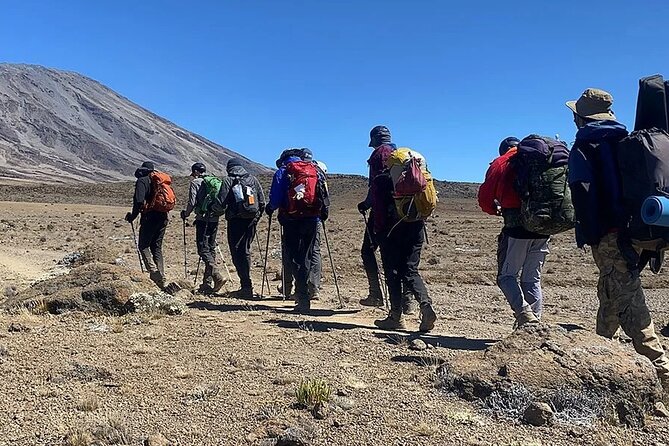
Rongai gives you a different first impression of Kilimanjaro. Instead of beginning on the busier southern side, you approach through Nalemuru village near the Kenyan border. The trail passes maize, beans, and potatoes before entering pine forest, so the opening hours feel tied to local life rather than designed only for hikers.
That northern position matters during the rainy season. The route generally sees less precipitation than the southern approaches, although mountain weather can change quickly and you still need waterproof clothing. You also get a true wilderness feel in the early stages, with black-and-white colobus monkeys among the possible wildlife sightings.
The trade-off is that Rongai does not offer the same gradual village-to-forest progression some other routes provide. Later, the trail joins the mountain’s eastern side and descends through Marangu territory. You get a quieter start, but not a completely separate mountain experience from beginning to end.
The group limit of 15 is reasonable for a major climb. It is large enough to share the cost of a full support team, but small enough for guides to keep track of the group. The crew includes mountain guides, assistant guides, camp staff, cooks, and porters. The guides hold Wilderness First Aid certifications, and the operator carries oxygen cylinders, oximeters, and medical kits.
More Rongai Route climbs:
- Kilimanjaro climb, Rongai Route (7-day)
★ 5.0 · 40 reviews - Kilimanjaro climb, Rongai Route (6-day)
★ 5.0 · 15 reviews - Mount Kilimanjaro Rongai Route
★ 5.0 · 10 reviews
Arrival in Moshi and the first hotel night
Your trip begins with pickup at Kilimanjaro International Airport. A Hilbas representative transfers you to the hotel, where you have a hot shower, a comfortable bed, a climb briefing, and a gear check.
That first night is more important than it sounds. It gives you time to recover from your flight and find any missing equipment before you go high on the mountain. Equipment rental is available for personal items such as sleeping bags and selected clothing or footwear, but you should confirm rental prices and stock before arriving.
The package includes two hotel nights, one before and one after the climb. Rooms are based on two people sharing, except on solo climbs. Airport transfers are also included at the start and end, which removes much of the usual arrival-day guesswork.
The stated meeting time is 9:00 a.m., but your exact pickup plan should be confirmed with the operator. Bring your passport, travel insurance details, personal medication, and any required visa documents. Flights, visas, and insurance are not included in the $2,282 price.
Day 2: From Nalemuru village to the pine forest
The first hiking day begins with transport from the hotel to Marangu Gate for registration and crew preparations. You then continue by vehicle to Rongai Gate, also called Nalemuru, a transfer that takes about three hours.
Lunch is served on the way or at the gate before you start walking. The trail begins around 1,900 meters and climbs to about 2,626 meters. You cover roughly 8 kilometers in six hours, moving through rainforest and pine forest.
The farmland at the start gives this day a useful sense of place. You see maize, beans, and potatoes before the path narrows into the trees. The route climbs gently, which is helpful on a first day when your main job is to settle into a slow, steady pace.
You might spot black-and-white colobus monkeys in the forest. Wildlife is never guaranteed, so treat this as a possibility rather than a planned feature. The more reliable reward is the change from cultivated fields to a quiet forest trail.
Day 3: Moorland, the second cave, and Mawenzi views
After breakfast, you continue from about 2,626 meters toward 3,600 meters, then descend slightly to a campsite around 3,450 meters. The distance is about 12 kilometers, with roughly seven hours of walking.
The route moves into moorland. You stop at the second cave for lunch, then cross a series of small rises and dips while heading southeast toward Mawenzi Peak. The campsite sits in a sheltered valley, a useful detail at this height where wind can make camp feel much colder than the thermometer suggests.
This is a good day to pay attention to pacing. The itinerary specifically calls for walking slowly, and that is sound advice. Kilimanjaro is not a race. A comfortable pace gives your body more time to adjust and lets you save strength for the summit night.
The change in vegetation is part of the appeal. The forest fades, the air becomes thinner, and the open moorland makes the mountain feel larger. At the same time, seven hours on uneven ground can be tiring, especially if you are still carrying too much in your day pack.
More treks and hikes around Kilimanjaro:
- Kilimanjaro climb by Lemosho Route (7-day)
★ 5.0 · 651 reviews - Kilimanjaro climb, Machame Route (7-day)
★ 5.0 · 262 reviews - Kilimanjaro Climbing Lemosho Route 8 Days.
★ 5.0 · 186 reviews - 8-Day Small-group Lemosho Kilimanjaro Summit Trekking
★ 5.0 · 186 reviews
Day 4: Mawenzi Tarn at 4,300 meters
Day 4 is shorter in distance but still demanding. You hike about 5 kilometers over roughly six hours, climbing from 3,600 meters to Mawenzi Tarn Hut at approximately 4,300 meters.
The trail rises steeply over grassy slopes before reaching a high basin with broad views toward Mawenzi Peak. You arrive around lunchtime, then have the afternoon to explore the area and rest at altitude.
This is one of the smartest parts of the route. You gain height, but you do not immediately sleep much higher. The afternoon gives you time to adjust before the next move toward Kibo. You should not treat the free time as an opportunity for a strenuous side hike. Eat, drink, keep warm, and let the mountain do its work.
Mawenzi Tarn is also one of the route’s memorable visual stops. Mawenzi has a sharp, rugged profile, and seeing it from this angle gives the climb more character than a simple march toward Kibo. The setting is exposed, so pack warm layers even if the morning in Moshi felt hot.
Day 5: Across the Saddle to Kibo Hut
From Mawenzi Tarn, you cross the Saddle, the broad high desert between Mawenzi and Kibo. The day covers about 10 kilometers in six hours, rising from 4,300 meters to roughly 4,720 meters at Kibo Hut.
The terrain becomes dry and spare. There is little shelter, and the route can feel stark, but the views across the mountain are excellent. Lunch may be packed for the trail or served hot at Kibo Hut, depending on your pace.
At Kibo, you eat an early dinner and go to bed. That early rest is not optional in practical terms. The summit attempt begins around midnight, so you need to make every possible hour of sleep count.
This is also the point where small packing mistakes become obvious. Keep your headlamp, gloves, warm layers, water, snacks, and personal medication ready before you lie down. You do not want to sort through a large bag at 11 p.m. in a cold mountain hut.
Day 6: The midnight summit attempt
Summit day is the hardest part of the experience by a wide margin. You wake around 11 p.m. for tea and biscuits, then start near midnight. The route climbs across volcanic scree toward William Point, Hans Meyer Cave, and Gillman’s Point on the crater rim.
The full day covers about 21 kilometers and takes around 15 hours. You climb from Kibo Hut at 4,720 meters to Uhuru Peak at 5,895 meters, then descend to about 3,720 meters. You move through alpine desert, Arctic conditions, and then moorland during the descent.
The section to Gillman’s Point is steep and covered with loose stone. It demands patience and mental strength as much as leg power. Hans Meyer Cave is described as a useful resting point, but you should expect short breaks rather than a long recovery stop.
From Gillman’s Point, the route continues around the crater rim toward Uhuru Peak, the highest point in Africa. The information provided does not give the exact distance or timing between Gillman’s Point and Uhuru, so your guide will set the pace according to conditions and your group’s progress.
After the summit, you descend to Kibo Hut, collect your gear, and continue down to the lower camp. This is why the day is so long. Reaching the summit is only the midpoint of the effort, and tired knees still have many hours of descending to handle.
The professional crew matters most here. The team carries oxygen and medical kits, uses oximeters, and includes guides with Wilderness First Aid certification. Those measures do not remove altitude risk, but they provide practical support if someone becomes unwell. You should still tell your guide promptly about headaches, nausea, unusual fatigue, confusion, or breathing trouble.
Day 7: Descending through Moorland and Rainforest
After breakfast, you continue down from about 3,720 meters to 2,720 meters. The descent covers around 19 kilometers and takes roughly eight hours, passing through moorland and rainforest before reaching Marangu Gate.
The vegetation changes quickly. Tall trees, flowers, and birds replace the sparse high-altitude terrain. After the open summit slopes, the return to forest feels refreshing, though the long descent can be hard on tired legs.
At Marangu Gate, everyone signs out and receives a completion certificate. A Hilbas vehicle then takes you back to the hotel. The drive passes coffee and banana farms around Marangu villages, adding a final look at the agricultural communities below the mountain.
You may be tempted to plan a celebration for the evening, but keep it simple. The schedule has you hiking for eight hours after summit night, so a shower, food, and sleep will likely be more useful than a late night out.
Food, camping, and the support crew
The package includes three meals a day on the mountain: breakfast, lunch, and dinner. Coffee, tea, Milo tea, water, and other listed drinks are included as well.
Vegetarian, vegan, lactose-free, gluten-free, halal, and other meal plans are available. Tell the company about your needs in advance. At altitude, regular meals and warm drinks are practical fuel, not an extra luxury.
Two people share a tent unless you pay for a single arrangement. The group equipment includes a dining tent, tables, chairs, crockery, and the camp setup needed by the crew. Porters carry the mountain equipment, while guides lead the route and cooks prepare meals.
The guide team has received especially strong praise for calm encouragement, care, and practical help. Hilary is one name associated with that support, along with Emmanuel and Felix. Bariki and Elinariki are also named in connection with the company’s mountain teams. Ask for the names and roles of your exact crew before departure, since staff can vary by date.
Tips for the crew are not included. You should budget for them separately and ask Hilbas for current guidance on fair amounts and how tips are distributed among guides, porters, cooks, and other staff.
Is $2,282 good value?
At $2,282 per person, this is not a low-cost hike. It is also not simply a six-day walk. The price covers two hotel nights, airport pickup and drop-off, mountain transport, park entry, camping and rescue fees, guides, porters, cooks, meals, drinks, group equipment, oxygen, and medical kits.
Those inclusions matter because Kilimanjaro costs build quickly. Park fees alone are substantial, and a private support system with porters, cooking staff, tents, and transport is far more involved than an ordinary guided day hike.
You still need to pay for flights, a Tanzanian visa, travel insurance, personal gear, laundry, phone use, souvenirs, crew tips, and any single-room or single-tent supplement. Personal equipment can be rented, but that cost is extra.
I consider the price reasonable for someone who wants an organized climb with airport handling and a full mountain crew. It is less attractive if you already have your own local logistics, camping equipment, or transport arrangements. Compare the exact inclusions carefully, especially guide-to-climber ratios, crew wages, rescue coverage, hotel quality, and rental costs.
Who should book this Rongai climb?
This route suits you if you want a quieter start, prefer a northern approach, or plan to climb during the rainy season. It also fits people who value a full support system and do not want to arrange hotels, transfers, meals, and mountain logistics separately.
You need moderate physical fitness at a minimum. The summit day is far tougher than the earlier itinerary suggests, with a midnight start, steep scree, high altitude, and a long descent. You should be comfortable walking for many hours and carrying a day pack, even though porters carry the main mountain equipment.
This is not the best choice if you want a short, easy mountain outing or dislike shared camping. It is also not ideal if you need a flexible schedule, since weather, altitude, and group pace can affect the day.
The maximum group size is 15. That gives you the social energy of a group climb, but people will move at different speeds. Ask how the company handles slower hikers and how assistant guides are assigned.
Booking details and cancellation terms
Confirmation is provided at booking, and the activity includes pickup. You should confirm the airport transfer, hotel name, room arrangements, exact guide team, equipment rental, and dietary needs before arrival.
The cancellation terms are strict close to departure. Cancel at least six full days before the start time for a full refund. Cancellation two to six full days before the start time receives a 50 percent refund, while cancellation within two days receives no refund. Changes follow the same timing limits.
Should you book it?
Book this Rongai climb if you want a quieter northern route, strong logistical support, and a real mountain progression from farmland to Arctic summit conditions. The Mawenzi Tarn acclimatization day, included park and rescue fees, airport transfers, and full camp crew make the $2,282 package easier to understand as a complete trip rather than just a hiking fee.
Before paying, confirm the exact crew, hotel details, equipment rental, tipping guidance, and how the company manages altitude problems. If you accept the demanding summit night and shared camping, this is a well-supported way to approach Kilimanjaro from its less-used side.
FAQ
How long is the Kilimanjaro experience?
The full program lasts about eight days. The mountain climb runs from Day 2 through Day 7, with one hotel night before the climb and one hotel night afterward.
How much does the climb cost?
The listed price is $2,282 per person.
Where does the Rongai Route begin?
The route begins near Nalemuru village at Rongai Gate, close to the Kenyan border on Kilimanjaro’s northern side.
Is airport pickup included?
Yes. Transportation from Kilimanjaro International Airport is included for pickup and drop-off.
Are hotel nights included?
Yes. Two hotel nights are included, with two people sharing a room except on solo climbs.
What meals are included?
Breakfast, lunch, and dinner are included on the mountain. The package also includes drinks such as coffee, tea, Milo tea, and water.
Can special diets be provided?
Yes. Vegetarian, vegan, lactose-free, gluten-free, halal, and other meal plans are available.
How difficult is the summit day?
The summit day covers about 21 kilometers and takes roughly 15 hours. It begins around midnight, reaches Uhuru Peak at 5,895 meters, and includes a steep scree section toward Gillman’s Point.
What is not included in the price?
Flights, a Tanzanian visa, travel insurance, personal gear, personal expenses, crew tips, and single accommodation supplements are not included.
What is the cancellation policy?
Cancel at least six full days before the experience for a full refund. Cancellation two to six full days before the start receives a 50 percent refund. Cancellation within two days is nonrefundable.
More Six-Day Trips in Kilimanjaro
- Kilimanjaro climb, Lemosho Route (6-day)
★ 5.0 · 129 reviews - Kilimanjaro climb, Marangu route (6-day)
★ 5.0 · 72 reviews - 6 Days Tanzania Classic Safari
★ 5.0 · 52 reviews - The Best of Machame Route in 6 Days: Your World’s Summit Guide
★ 5.0 · 44 reviews
Just added around Kilimanjaro
- 6 days Machame route climbing Mt.Kilimanjaro★ 5.0 · 8 reviews
- machame route★ 5.0 · 16 reviews
- Mt Kilimanjaro 6 days Marangu route hike★ 5.0 · 3 reviews
- Private Cycle to Kilimanjaro Bike Park Safari★ 5.0 · 6 reviews
- West Kilimanjaro cycling Adventures★ 4.5 · 8 reviews
- Kilimanjaro Climb • Marangu Route ~ 9 Day★ 5.0 · 4 reviews
- 3 Days Private E-Bike Tour in West Kilimanjaro★ 5.0 · 3 reviews
- Kilimanjaro Climb • Machame Route ~ 10 Day★ 5.0 · 6 reviews