
Reviewed · RONGAI ROUTE CLIMBS
Kilimanjaro climb, Rongai Route (7-day)
Kilimanjaro’s Rongai Route gives you a quieter way up Africa’s highest mountain, approaching from the Kenyan side before crossing high moorland, rocky semidesert, and the icy summit zone. The route takes seven climbing days, with hotel nights before and after, and reaches Uhuru Peak at 5,895 meters.
I like the careful acclimatization plan, especially the short practice hikes above Second Cave and Mawenzi Tarn. I also like the strong support setup: walk-in North Face tents, three meals a day, medical checks, oxygen, and guides trained as Wilderness First Responders. The main caution is simple: this is still a demanding high-altitude climb, and summit night is long, cold, and physically draining.
Key points to know before booking
- Rongai is the quieter northern approach: You begin at Nalemuru Gate and finish near Marangu Gate, seeing two sides of Kilimanjaro.
- Acclimatization is built into the schedule: Short uphill walks followed by sleep at a lower camp help your body adjust.
- The summit night lasts about 12 hours: You climb from roughly 4,700 meters to Uhuru Peak, then descend to Horombo Camp.
- Your crew handles the heavy work: Porters carry equipment, cooks prepare meals, and camp staff set up tents before you arrive.
- The package is unusually broad: Park fees, airport transfers, two hotel nights, meals on the mountain, equipment, medical checks, and oxygen are included.
- The price is $3,507 per person: It can be good value if you use the included services, but gear, insurance, visas, and tips remain extra.
Why the Rongai Route feels different
Rongai is the only Kilimanjaro route that approaches from the northern side. That matters because the opening days are generally quieter than the more heavily used southern approaches. You begin in forest, then move toward broad open country with views of Kibo and Mawenzi, Kilimanjaro’s two main volcanic peaks.
The route is also appealing because it does not rush you toward altitude. You spend the first night at 2,625 meters, then move to 3,480 meters, with an acclimatization walk higher before returning to sleep lower. Later, you repeat the pattern near Mawenzi Tarn.
That schedule cannot remove the risk of altitude sickness, but it gives you time to notice how your body is responding. The guides conduct health checks, and the listed equipment includes oximeters, medical kits, and oxygen. Take those safeguards seriously, but do not treat them as a guarantee that everyone will reach the top.
More Rongai Route climbs:
- Kilimanjaro climb, Rongai Route (6-day)
★ 5.0 · 15 reviews - Mount Kilimanjaro Rongai Route
★ 5.0 · 10 reviews - 6-Day Rongai Route Trek in Mount Kilimanjaro
★ 5.0 · 8 reviews
Day 1: A hotel briefing before the mountain
Your trip begins with pickup at Kilimanjaro International Airport and a transfer to Aishi Machame Hotel in the foothills. The hotel includes hot water, internet access, a swimming pool, and two people per room unless you pay for single accommodation.
Check-in begins at 2:00 PM. The evening briefing is useful for more than introductions. It is your chance to confirm the plan, ask about the weather, check your equipment, and make sure you understand the pace and safety rules.
You receive dinner and breakfast at the hotel only if those meals are part of the arranged schedule. Lunch and dinner at the hotel are listed as extra, so budget for those meals outside the mountain package.
Day 2: From Nalemuru Gate to Simba Camp
The first mountain day begins at Nalemuru Gate, at about 2,020 meters. Your head guide handles permits and search-and-rescue registration while the crew prepares for the trek.
The walk to Simba Camp rises through Kilimanjaro’s northern conifer forest and takes about five hours. This is described as a moderate start, but you should resist the temptation to hurry. A slow, steady pace now protects your energy for the high camps later.
Simba Camp sits at 2,625 meters. Your tents should already be ready when you arrive, and the kitchen team serves dinner. That is one practical advantage of a supported climb: you carry your daypack while porters move the camping and cooking equipment.
From the start, follow the basic rules given by the guides. Drink regularly, walk slowly, report symptoms early, and do not try to prove your fitness by racing ahead.
Day 3: Second Cave and the first acclimatization walk
The hike from Simba Camp to Second Cave Camp takes about three hours and rises to 3,480 meters. It is one of the easier days, which is exactly the point. You reach camp early enough to eat lunch, rest, and look around before the next activity.
After your break, you make an acclimatization walk toward Kikilewa Camp, gaining about 100 meters before returning to sleep at Second Cave. This is the classic high-altitude idea of walking higher but sleeping lower.
Do not dismiss this as a spare outing. The walk gives the guides a chance to see how you move and how you respond to altitude. It also gives you a gentle introduction to the breathing pattern and pace needed above the forest.
More treks and hikes around Kilimanjaro:
- Kilimanjaro climb by Lemosho Route (7-day)
★ 5.0 · 651 reviews - Kilimanjaro climb, Machame Route (7-day)
★ 5.0 · 262 reviews - Kilimanjaro Climbing Lemosho Route 8 Days.
★ 5.0 · 186 reviews - 8-Day Small-group Lemosho Kilimanjaro Summit Trekking
★ 5.0 · 186 reviews
Day 4: Kikilewa Camp and a useful rest period
The trail continues to Kikilewa Camp at 3,630 meters, with Kibo often visible when clouds stay away. The day takes up to eight hours, though the exact effort will depend on the group’s pace and trail conditions.
This is described as a relief day, and the schedule includes time to sleep after lunch. Use it. High-altitude rest is not wasted time, and a nap may help more than extra sightseeing around camp.
In the evening, the guide checks each person’s condition and explains the next day. This personal attention is one of the strongest parts of the setup. The climb is private to your group, so the guides can focus on your pace rather than managing a large public departure.
Day 5: Mawenzi Tarn beneath the second volcano
You leave Kikilewa early and walk toward Mawenzi Tarn Camp, at the foot of Mawenzi Volcano. Mawenzi has a jagged profile that feels very different from Kibo’s broad summit, and this is one of the most memorable camp settings on the route.
After arriving, you eat lunch and rest for about two hours. The acclimatization hike then gains roughly 200 meters toward Mawenzi before you return to camp for dinner.
This day lasts about seven hours, but the repeated up-and-down walking can be tiring. Keep your boots comfortable, protect your feet, and use the afternoon rest. You are preparing for the highest and hardest part of the climb, not trying to squeeze in every possible view.
Day 6: Kibo Camp and the rocky semidesert
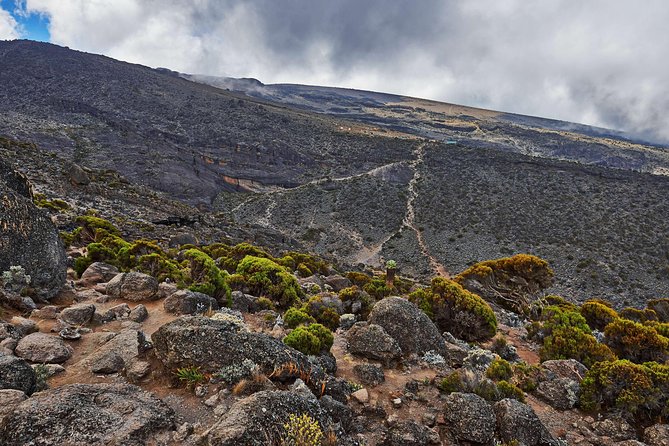
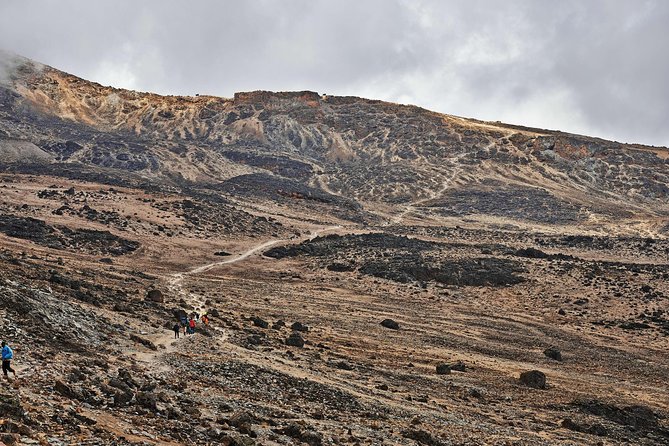
The route to Kibo Camp rises to about 4,700 meters. The forest and moorland disappear, replaced by a rocky semidesert with less shelter and a more exposed feel.
The walking itself is not described as technically difficult, but altitude changes the rules. A short incline can leave you breathless, and a pace that felt easy lower down may be too fast here. Listen to the guides and keep your steps short.
This is a long day, listed at about 14 hours, because the schedule leads into the summit attempt. Once you reach camp, eat, drink, avoid strenuous activity, and sleep if you can. Your summit departure is during the night.
One detail needs checking before you travel: the itinerary refers to both Kibo Summit Camp and School Hut Camp, with elevations listed around 4,700 to 4,715 meters. Ask the operator to confirm the exact camp used on your departure date.
Day 7: Uhuru Peak, then the long descent
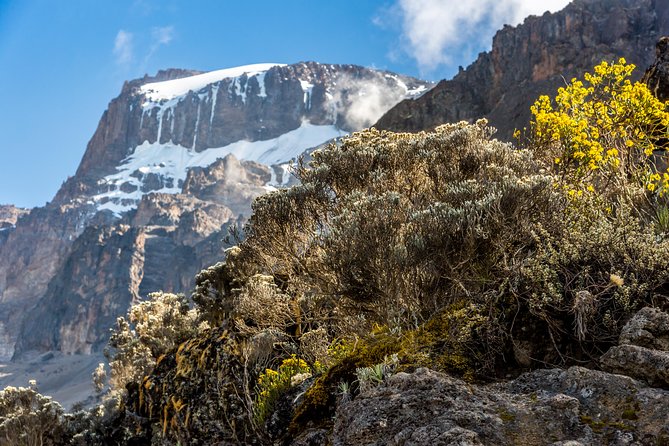
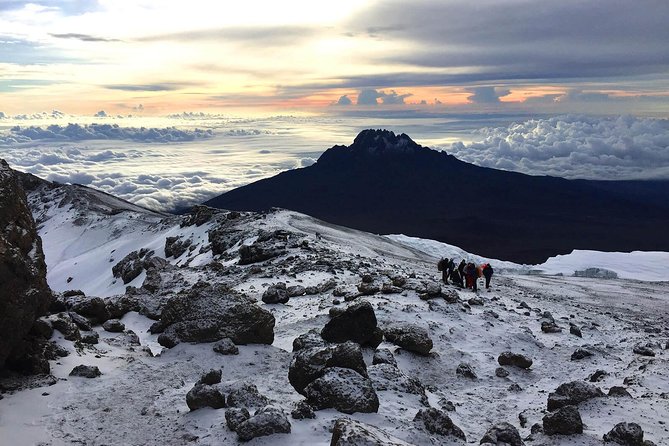
Summit night starts around midnight from the high camp. The climb to Uhuru Peak is not usually presented as a technical ascent, but the altitude places heavy strain on your heart and lungs. The route is slow, cold, and demanding, even if the gradient is moderate.
The listed guide ratio becomes especially reassuring here: one guide for every two climbers during the summit push. Guides assess your condition as you climb, and you should be honest about headaches, nausea, dizziness, unusual breathlessness, or confusion.
At 5,895 meters, Uhuru Peak is the high point of the trip. The plan also allows a walk near the nearest glacier if conditions and energy permit. Do not turn that option into an obligation. The summit is enough.
The descent is where tired legs and loose footing become a problem. You rest for about two hours at Kibo Camp before continuing to Horombo Camp at roughly 3,720 meters. Concentrate on every step, especially after the excitement of the summit has worn off.
Day 8: Marangu Gate and the return to the hotel
After breakfast, you make the final descent to Marangu Gate at about 1,860 meters. The five-hour walk brings you back into a lower, greener zone and ends the mountain portion of the trip.
At the gate, you can say goodbye to the support crew and receive your climbing certificate at the company offices before returning to the hotel. This is also when tipping is normally handled, though tips are not included in the price. Carry enough local currency or ask in advance about the preferred method.
The hotel night is valuable. You can shower, sleep in a proper bed, sort your gear, and let your body recover before airport travel.
Day 9: Airport transfer and a practical departure day
The final day includes rest at Aishi Machame Hotel and a transfer to the airport. Hotel check-out is at 11:00 AM.
If your flight is later in the day, a late check-out can be arranged for an additional fee. That may be worth paying for after seven days on the mountain, especially if you want a shower and a quiet place to repack.
Airport pickup and drop-off, plus ground transport connected with the climb, are included. You still pay for your international travel to Tanzania and any visa charges.
What the $3,507 price includes
At $3,507 per person, this is not a budget trek. It is also more than a simple permit-and-guide arrangement. The package includes two hotel nights, park fees, airport transfers, ground transport, mountain tents, sleeping pads, dining equipment, three meals daily, drinks, porters, cooks, camp staff, and certified Wilderness First Responder guides.
Medical support is another meaningful inclusion. The crew carries oxygen, oximeters, and medical kits, and conducts health checks during the climb. That does not replace proper insurance, but it gives you a stronger support system than a basic guided walk.
You still need to pay for flights, visas, personal clothing, boots, a sleeping bag, trekking insurance, helicopter evacuation coverage, and tips. Gear can be hired, which may help if you do not expect to use high-altitude equipment again.
Single accommodation in the hotel and a private tent are available for an additional fee. Solo climbs also change the standard two-person room and tent arrangement.
Food, tents, and the human side of the climb
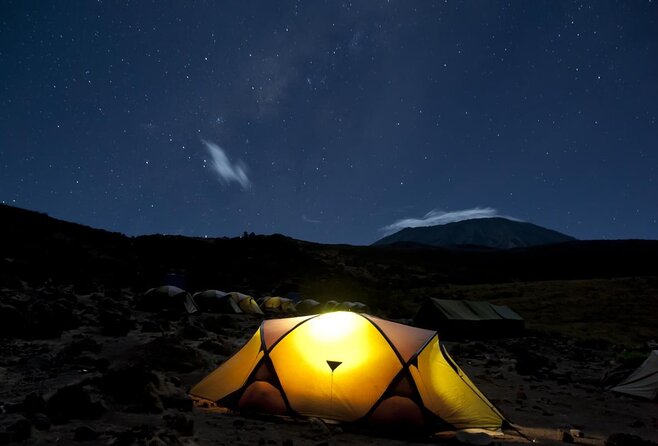
The camping setup aims for comfort rather than luxury. You sleep in North Face VE-25 tents, with two climbers per tent, while the crew manages the dining tent, tables, chairs, crockery, and cooking.
Three energy-focused meals are provided each day. Vegetarian, gluten-free, halal, and other meal needs can be arranged. Tea, coffee, juice, soda, and similar drinks are also listed for the mountain.
The human side of the climb matters just as much as the gear. Named guides in the trip accounts include Jackson, Joseph, Frank, Athumani, Amos, Elia, and Solomon, while camp staff such as Ivan, Leonard, and Evance were singled out for their care, food, and daily help. Your own crew may be different, but the repeated pattern is clear: guide support and porter service are a major part of what you are paying for.
One especially useful detail is that the kitchen team may prepare baked treats and special touches for celebrations. That will not make the summit easier, but a warm meal or small surprise can lift morale after a wet or exhausting day.
Who should choose this climb
I would look closely at this route if you want a quieter approach, a full seven-day schedule, and strong support at altitude. It suits people with moderate physical fitness who are willing to train for long uphill days and a difficult night ascent.
It can also work well for families or first-time high-altitude climbers, provided everyone understands the effort involved. The acclimatization walks and private group format give the guides room to adjust the pace.
I would hesitate if you want a short holiday with a guaranteed summit. No operator can promise that. Weather, altitude, illness, and exhaustion can all change the plan, and the high camps are not comfortable in the ordinary sense.
The best preparation is steady hill walking, stair training, and practice with your boots and daypack. Bring a sleeping bag suitable for high mountain temperatures, or confirm the rental choice well before departure. Insurance covering trekking to 6,000 meters and helicopter evacuation is strongly recommended.
Should you book the Rongai Route?
Book it if you value a quieter trail, careful acclimatization, and a large amount of practical support in one price. The guides, porters, cooks, medical checks, hotel nights, and transfers make the $3,507 cost easier to justify than a stripped-down climb.
Do not book it expecting an easy scenic hike. The route is gentler in profile than some alternatives, but summit night remains a serious physical test. Confirm the Kibo Camp and School Hut details, ask about gear rental, arrange high-altitude insurance, and budget for tips and hotel meals.
For a first Kilimanjaro attempt, the seven-day Rongai schedule offers a sensible balance of quieter trails, gradual height gain, and professional support. It is a demanding trip, but the structure gives you a fair chance to reach Uhuru Peak without rushing the mountain.
FAQ
How long does the full experience last?
The full trip lasts about nine days, including hotel nights before and after the seven-day mountain climb.
Where does the climb begin and end?
The climb begins at Nalemuru Gate on Kilimanjaro’s northern side and finishes at Marangu Gate.
What altitude does Uhuru Peak reach?
Uhuru Peak reaches 5,895 meters.
Are meals included on the mountain?
Yes. Three meals a day are provided during the climb, along with drinks such as tea, coffee, juices, and soda. Vegetarian, gluten-free, halal, and other meal options are available.
Is airport transportation included?
Yes. Pickup and drop-off at Kilimanjaro International Airport, along with the listed ground transportation, are included.
What do I need to pay for separately?
You pay separately for international travel to Tanzania, visas, personal hiking equipment, sleeping bags, insurance, helicopter evacuation coverage, tips, hotel lunches and dinners, and optional single accommodation.
More Seven-Day Trips in Kilimanjaro
- Climbing Kilimanjaro through 7 days Machame Route
★ 5.0 · 151 reviews - 7-Day Machame Kilimanjaro Summit Tour from Arusha
★ 5.0 · 125 reviews - 7 Days Kilimanjaro via Machame route affordable price
★ 5.0 · 110 reviews - Private Kilimanjaro Hike 7 Day Lemosho Route
★ 5.0 · 60 reviews
Just added around Kilimanjaro
- 6 days Machame route climbing Mt.Kilimanjaro★ 5.0 · 8 reviews
- machame route★ 5.0 · 16 reviews
- Mt Kilimanjaro 6 days Marangu route hike★ 5.0 · 3 reviews
- Private Cycle to Kilimanjaro Bike Park Safari★ 5.0 · 6 reviews
- West Kilimanjaro cycling Adventures★ 4.5 · 8 reviews
- Kilimanjaro Climb • Marangu Route ~ 9 Day★ 5.0 · 4 reviews
- 3 Days Private E-Bike Tour in West Kilimanjaro★ 5.0 · 3 reviews
- Kilimanjaro Climb • Machame Route ~ 10 Day★ 5.0 · 6 reviews