
Reviewed · LEMOSHO ROUTE CLIMBS
Kilimanjaro Trekking 7Days 6Night Lemosho Route
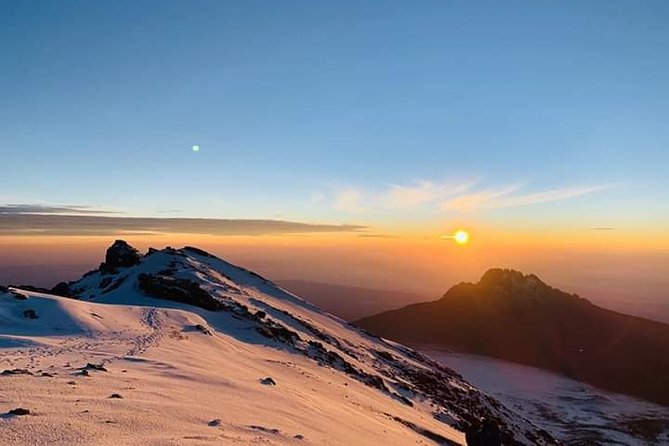
Kilimanjaro’s Lemosho Route gives you the mountain in chapters: forest, moorland, high volcanic slopes, glaciers, and a final night climb toward Uhuru Peak. It is the prettier route described here, with fewer climbers than the busier options, but it is not an easy week in the hills.
I like the small group limit of 10, since it gives your guides more time to watch your pace and altitude symptoms. I also like the strong team focus: guides named in the company’s trip accounts include Francis, Peter, Sanga, Nguma, Innocent, and Kissima, while cooks such as Schabari are praised for keeping meals varied at altitude.
The main caution is the itinerary itself. The supplied schedule gives only partial details for Days 3 and 6, even though Day 6 is clearly intended to include the summit push. Ask for the full day-by-day plan, exact gear arrangements, and transfer details before paying the $3,000 price.
Key points to know before you book
- The Lemosho start reaches Mti Mkubwa at 2,650 meters, after a drive to Londorossi Gate and a forest hike with a park ranger.
- Shira 2 arrives on Day 2, with a long 16-kilometer hike across giant heather and volcanic rock.
- Barranco Wall is the route’s hands-on challenge, followed by a descent into Karanga Valley.
- Barafu Camp is the high staging point, where you prepare for the final climb toward Uhuru Peak.
- The group maximum is 10 people, and the package includes park fees, trekking, breakfast, lunch, dinner, and camping equipment.
- The descent ends at Mweka Gate, where you receive summit certificates before returning to your hotel.
What the $3,000 Kilimanjaro package really gives you
At $3,000 per person, this is a serious purchase, but not an unreasonable one for a guided Kilimanjaro climb. The price includes all fees and taxes, the trek itself, six breakfasts, seven lunches, and six dinners. Camping equipment is also presented as included, and pickup is offered.
That matters because Kilimanjaro is not a simple walk where you arrive with a daypack and buy a ticket at the gate. Your package needs to cover park access, mountain staff, food, camp support, and the logistics of moving you from Moshi to the trailhead and back again.
Still, I would ask a few direct questions before booking. The general information says all camping equipment is included, while trip accounts also refer to renting items such as sleeping bags and summit gear from the company. Find out exactly what is supplied and what costs extra. Your personal clothing, boots, gloves, headlamp, water system, and other mountain essentials may not be part of the package.
Pickup is offered, but the listing does not clearly spell out every transfer included in the $3,000. Ask if airport pickup, hotel pickup, and the return drive from Mweka Gate are included in your quoted price. One useful detail is clear: after the descent, a vehicle waits at Mweka Gate to take you back to your hotel.
The Tanzanian visa is separate. The stated cost is $50 per person, or $100 for American residents, payable on arrival at the airport. Confirm the current visa rules before departure, since border requirements can change.
More Lemosho Route climbs:
- Kilimanjaro climb by Lemosho Route (7-day)
★ 5.0 · 651 reviews - Kilimanjaro Climbing Lemosho Route 8 Days.
★ 5.0 · 186 reviews - 8-Day Small-group Lemosho Kilimanjaro Summit Trekking
★ 5.0 · 186 reviews
Starting through the Lemosho forest on Day 1
Your first morning begins with a briefing and a gear check. That is valuable. A bad jacket, worn-out boot, or missing warm layer can become a serious problem later, so let the guides inspect what you have before leaving Moshi.
The drive to Londorossi Park Gate takes about three hours. After registration, you begin walking with an armed park ranger. The first trail passes through forest where buffalo, elephant, and other wildlife may be present. Wildlife sightings are not promised, but the possibility gives this opening day more character than a simple transfer to a campsite.
The hike itself is short by mountain standards: about two to three hours and six kilometers. You finish at Mti Mkubwa Camp, at 2,650 meters. This is a sensible first day because you gain altitude without exhausting yourself before the longer stages begin.
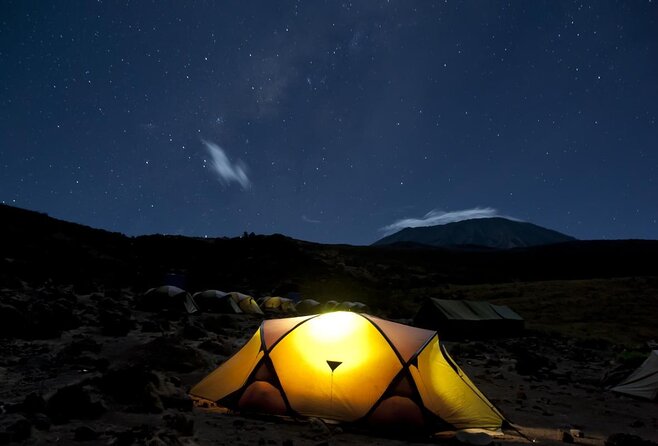
Your first night also gives you a quick lesson in camp life. You will be eating dinner, sleeping, and preparing for the next morning at altitude. The quality of your guide team matters here. Past trip accounts repeatedly single out friendly support from the guides, porters, and cook, so use the first evening to understand how the team handles water, meals, packing, and pace.
Crossing the Shira Plateau on Day 2
Day 2 is the first substantial test. You hike for seven to eight hours and cover about 16 kilometers, moving from the forest into the giant heather moorland zone.
This is where the Lemosho Route starts to feel like a high mountain journey. The vegetation thins, volcanic rock appears, and the trail crosses several streams. You climb toward Shira Ridge, with possible views of Uhuru Peak if clouds stay away. The Northern Ice Fields may also come into view on the western side of Kilimanjaro.
The destination is Shira 2 Camp at 3,850 meters. That is a major gain from Mti Mkubwa, so the long, steady pace is more important than speed. Your guides may encourage the famous pole pole rhythm, meaning slowly and steadily. Do not treat the first clear stretch as a race. The real test comes later, and saving energy is part of the plan.
The attraction here is the open scenery and the lower number of climbers compared with busier routes. The drawback is the distance. Sixteen kilometers is a full day on uneven ground, and the altitude can make a normal walking pace feel surprisingly slow.
The missing details for Day 3 matter
The supplied schedule does not provide a complete description for Day 3. That is not a small paperwork issue. On a seven-day Kilimanjaro trip, the middle days are important because they shape your acclimatization before the hardest climb.
The available itinerary text repeats the first two days instead of giving the route, camp, distance, elevation, or hiking time for Day 3. Before you book, request this information in writing. You should know where you sleep, how high the camp is, how long you walk, and how the day helps prepare you for the summit.
The broader route description indicates that the climb continues through the mountain’s changing climatic zones and later joins the southern circuit. But I would not fill in the missing day from memory or assume every company uses the same schedule. Get the exact plan from Uprise Africa Explorer.
This is also a good point to ask how your guides manage altitude symptoms. The team is praised for giving advice when climbers felt unwell, but your own health remains your responsibility. Tell the guides early if you have a headache, nausea, unusual tiredness, or trouble sleeping. Hiding symptoms to keep up is a poor bargain.
More treks and hikes around Kilimanjaro:
- Kilimanjaro climb, Machame Route (7-day)
★ 5.0 · 262 reviews - Climbing Kilimanjaro – Machame Route
★ 5.0 · 170 reviews - Climbing Kilimanjaro through 7 days Machame Route
★ 5.0 · 151 reviews - Kilimanjaro climb, Lemosho Route (8-day)
★ 5.0 · 148 reviews
Barranco Wall and Karanga Valley on Day 4
Day 4 covers about five kilometers in three to four hours, but distance is not the main story. You leave Barranco Camp and climb the Barranco Wall, reaching the top after roughly an hour and a half.
The wall is steep, but this is not described as a technical climbing section. Expect to use your hands in places and pay attention to where you put your feet. The guides are there to set a safe pace and help the group move through the more awkward sections.
At the top, the route becomes more level before descending into Karanga Valley at about 4,050 meters. You then reach the junction connecting with the Mweka Trail and spend the night at Karanga Camp.
I like this day because it gives you a physical challenge without requiring a huge mileage total. It also shows why Kilimanjaro is more than a simple uphill walk. You climb, descend, and climb again, using the trail’s shape to gain altitude at a manageable rate.
Barafu Camp and the final preparation
Day 5 is another short mileage day, about four kilometers and three to four hours, as you climb to Barafu Camp. You have completed the South Circuit, which gives you views of the summit and glaciers from different angles.
Barafu is the key staging camp for the final ascent. You set up camp with the summit above you, then rest and prepare for the most demanding portion of the trip. The itinerary says you have views of the summit, but clouds and weather can change what you see.
This is where your earlier pacing decisions pay off. A long lunch stop, a slow walk, enough food, and careful attention to hydration are more useful than trying to prove your fitness. The company’s cooks are frequently praised, including Schabari, whose food is said to be a highlight. That matters because appetite often drops at altitude, and a meal you can actually eat is worth a great deal.
Day 5 may look easy on paper. Do not mistake it for a relaxed sightseeing day. You are gaining height, sleeping high, and saving strength for the summit schedule.
The summit day needs a clearer description
The Day 6 entry gives a five-hour hiking time but does not include the full route description in the information provided. Based on the sequence, this is the summit day, followed by a descent toward the lower camp. Confirm the exact timing with the operator before departure.
The summit push is the part you need to understand most clearly. Ask when you leave Barafu, when you expect to reach Uhuru Peak, where you rest afterward, and which camp you use that night. The published itinerary should state those points.
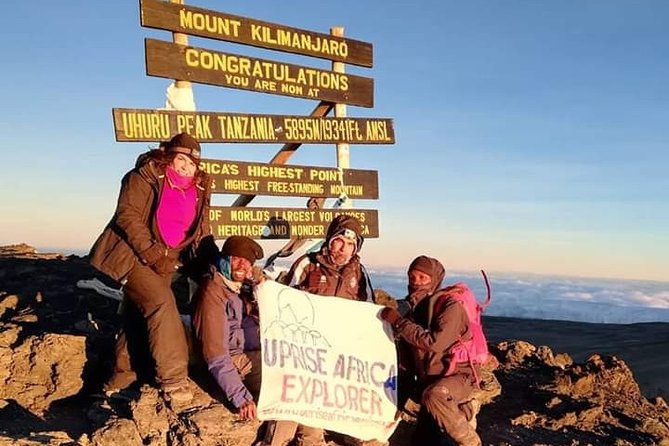
The tour is designed to reach Africa’s highest mountain, and summit certificates are issued after the final descent. But a summit attempt is affected by altitude, weather, and individual health. A supportive guide can help you make good decisions, but no company can promise that every person reaches the top.
The team’s reputation for staying upbeat and helping climbers is one of the package’s strongest features. Names connected with past groups include Francis, Peter, Sanga, Nguma, Innocent, and Kissima. Ask who your lead guide will be, how many assistant guides are assigned, and how the guide-to-climber ratio works for your departure.
Descending to Mweka Gate on Day 7
After breakfast at about 3,090 meters, you descend to Mweka Park Gate. The stated hiking time is three to four hours over 10 kilometers.
The descent is often easier on the lungs than the ascent, but it can be tiring on the knees and feet. Give yourself time to walk carefully. After seven days in mountain boots, even a moderate downhill trail can feel long.
At Mweka Gate, you receive your summit certificates. A vehicle then takes you back to your hotel. That final transfer is welcome because the body is usually ready for a shower, a proper bed, and a meal that does not come from a camp kitchen.
How the guides and mountain crew shape the trip
On Kilimanjaro, the staff can make the difference between a well-run week and a stressful one. The most consistent praise here goes to the guides, porters, and cook. The team is described as friendly, skilled, helpful, and positive from the first briefing to the final descent.
Past groups have named Francis as a strong head guide, with Peter working as an assistant. Sanga, Nguma, Innocent, and Kissima are also connected with successful climbs. These names are not a promise that one of them will lead your departure, so ask who is assigned to your group.
The food receives special attention. Schabari is praised for creating good meals on the mountain, and several accounts describe the food as excellent or spectacular. Your package includes seven lunches, six breakfasts, and six dinners, which covers the stated six-night schedule plus the longer lunch count.
Porters are another important part of the operation. The trip accounts praise their help, but you should still ask how the company handles porter welfare, baggage limits, tips, and staff numbers. A fair, clear arrangement is better for everyone on the mountain.
Who will get the most from this route
This climb suits you if you want a scenic Kilimanjaro route, prefer a smaller group, and are willing to spend a full week walking at altitude. It also suits people who value direct support from a local team and want meals, park fees, and camp logistics handled in one package.
It may not suit you if you want a relaxed holiday with flexible daily plans. The second day alone involves up to eight hours of hiking, and the summit schedule is physically demanding. You also need to be comfortable camping for six nights and dealing with changing weather.
The activity information says most people can participate, but that should not replace personal medical advice. Kilimanjaro is high enough that fitness alone does not guarantee an easy climb. If you have medical concerns, speak with a qualified clinician before booking.
The group maximum of 10 is a useful middle ground. You get some company on the trail without joining a huge party. Smaller groups can also move at a more suitable pace, though the actual group size for your date should be confirmed.
Booking, cancellations, and practical questions
Confirmation is provided at booking, and the stated start time is 11:00 am. Since the first day includes a long drive and a park registration process, confirm the exact meeting point and pickup time with the operator.
The cancellation terms are strict near departure. Cancel at least six full days before the start for a full refund. Cancel two to six full days before and the stated refund is 50 percent. Within two full days, there is no refund, and changes are not accepted.
The activity requires good weather. If poor weather forces cancellation, you are offered another date or a full refund. That protection is useful, but it does not cover every personal change of plan, so read the timing rules carefully.
Should you book the seven-day Lemosho Route?
I would consider this trip a strong choice if your priority is a scenic route, a small group, and an experienced mountain support team. The best parts are clear: the Lemosho scenery, the quieter trail feel, the carefully staged camps, included meals and fees, and repeated praise for the guides and cook.
I would book only after getting the missing Day 3 and Day 6 details in writing. I would also confirm exactly which camping and summit gear is included, who will guide your departure, and how airport or hotel transfers fit into the $3,000 price.
If those points are clear, this is a well-priced way to approach Kilimanjaro with a local team and a good amount of support. If you want a short or simple mountain holiday, choose something easier. If you want the longer, scenic route and are ready for a demanding week, the Lemosho plan is worth serious consideration.
FAQ
How long is the Kilimanjaro Lemosho Route tour?
The tour lasts approximately seven days and six nights.
How much does the climb cost?
The listed price is $3,000 per person.
What route does the climb use?
The climb uses the Lemosho Route, beginning near Londorossi Park Gate and later joining the southern circuit toward Karanga and Barafu.
How many people can join the group?
The maximum group size is 10 travelers.
What meals are included?
The package includes seven lunches, six breakfasts, and six dinners.
Are park fees and taxes included?
Yes. All fees and taxes are included in the stated package.
Is pickup available?
Pickup is offered. Confirm the exact pickup location and which transfers are included in your price before booking.
Is a Tanzanian visa included?
No. The stated visa cost is $50 per person, or $100 for American residents, payable on arrival at the airport.
What happens if bad weather cancels the climb?
If poor weather causes the experience to be canceled, you will be offered a different date or a full refund.
More Seven-Day Trips in Kilimanjaro
- 7-Day Machame Kilimanjaro Summit Tour from Arusha
★ 5.0 · 125 reviews - 7 Days Kilimanjaro via Machame route affordable price
★ 5.0 · 110 reviews - Private Kilimanjaro Hike 7 Day Lemosho Route
★ 5.0 · 60 reviews - 7 Days Machame route – Kilimanjaro
★ 5.0 · 45 reviews
Just added around Kilimanjaro
- 6 days Machame route climbing Mt.Kilimanjaro★ 5.0 · 8 reviews
- machame route★ 5.0 · 16 reviews
- Mt Kilimanjaro 6 days Marangu route hike★ 5.0 · 3 reviews
- Private Cycle to Kilimanjaro Bike Park Safari★ 5.0 · 6 reviews
- West Kilimanjaro cycling Adventures★ 4.5 · 8 reviews
- Kilimanjaro Climb • Marangu Route ~ 9 Day★ 5.0 · 4 reviews
- 3 Days Private E-Bike Tour in West Kilimanjaro★ 5.0 · 3 reviews
- Kilimanjaro Climb • Machame Route ~ 10 Day★ 5.0 · 6 reviews