
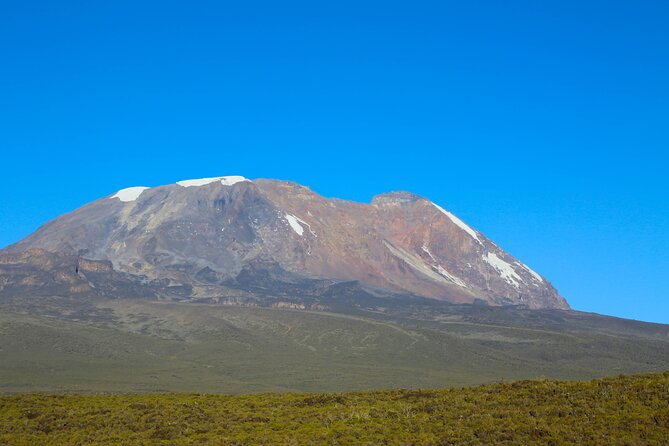
Reviewed · RONGAI ROUTE CLIMBS
Kilimanjaro Climbing Rongai Route
Kilimanjaro’s Rongai Route gives you a long, gradual approach from the Kenyan side, then brings you into the mountain’s stark upper world: Mawenzi’s jagged spires, the lunar saddle, and a sunrise summit push. I like the route’s quieter feel and its changing scenery, from possible wildlife in the forest to glaciers near Uhuru Peak. I also like that Habari Adventure uses local guides trained in first aid and safety, with named guides such as Leon, Emmanuel, and Innocent praised for patience and care.
The main drawback is the summit day. It lasts about 15 hours, begins around midnight, and includes the steepest hiking of the trip. The $2,840.39 price is also a serious commitment, and the supplied details do not spell out every inclusion, so you should confirm exactly what is covered before paying.
Key points to know before you book
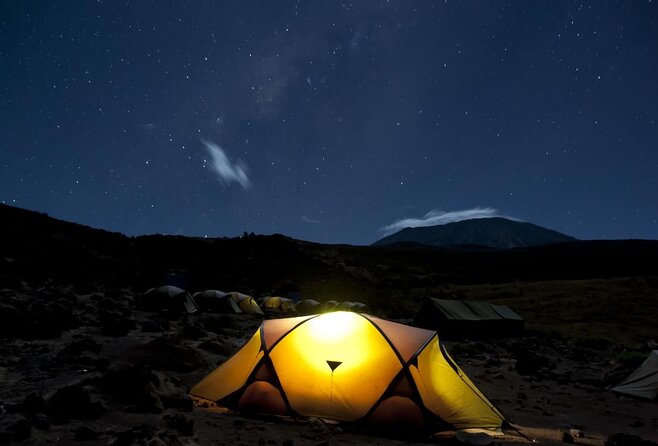
- Rongai starts near the Kenyan border: You drive from Moshi to Nalemoru Gate, then enter the forest on the quieter northern side of Kilimanjaro.
- The route takes seven days: Daily hikes are generally three to five hours until summit day, followed by a long descent through Horombo and Mandara.
- The summit push is demanding: You leave Kibo Hut around midnight, reach Gilman’s Point at 5,685 meters, then continue to Uhuru Peak at 5,895 meters.
- Mawenzi is the visual highlight: Camps at Kikelelwa and Mawenzi Tarn place you beneath the dramatic spires of Kilimanjaro’s second-highest volcanic cone.
- Groups can reach 15 people: That is small enough for guide contact, but not the same as a private climb.
- The company emphasizes local support: Guides come from Tanzania and are trained in safety and first aid, with strong praise attached to Leon, Emmanuel, and Innocent.
Why the Rongai Route feels different
Rongai approaches Kilimanjaro from the northeast, close to the Kenyan border. That gives the opening days a different character from routes that begin on the mountain’s southern or western sides. Your first major drive is part of the outing: after breakfast in Moshi, you travel to Nalemoru Gate and begin walking from there.
I like this route for its measured start. The first two days are not designed to punish you. They let you settle into the rhythm of walking slowly, eating regularly, and sleeping at altitude. The forest can also bring a little surprise, with possible sightings of zebras, elephants, buffalos, and monkeys. Wildlife is never guaranteed, so treat this as a pleasant possibility rather than a promised safari.
The route later joins the upper Kilimanjaro system and takes you toward Mawenzi, one of the three volcanic peaks that make up the mountain. The scenery changes quickly. Forest gives way to moorland, then grassy high slopes, volcanic rock, and the pale saddle between Mawenzi and Kibo.
More Rongai Route climbs:
- Kilimanjaro climb, Rongai Route (7-day)
★ 5.0 · 40 reviews - Kilimanjaro climb, Rongai Route (6-day)
★ 5.0 · 15 reviews - Mount Kilimanjaro Rongai Route
★ 5.0 · 10 reviews
Day 1: Nalemoru Gate and the first forest climb
Your morning begins with pickup from your hotel in Moshi, followed by the drive to Nalemoru Gate. The listed meeting information also mentions Kilimanjaro Airport and Kilimanjaro National Park, with an 8:00 am start, so clarify your exact pickup point when booking.
The opening hike takes about three hours. You climb gradually through tropical forest, which makes this a friendly first day for finding your pace. Do not race ahead. The point is to save energy and let your body begin adjusting to the mountain.
This is also the day with the best chance of seeing animals, although the information only says you may spot zebras, elephants, buffalos, and monkeys. Keep your eyes open, but do not expect a wildlife-viewing trip. Your main focus remains the climb.
Day 2: Second Cave Camp and the first high views
The second day takes about four hours and moves into the moorland zone. This is where the mountain begins to feel less like a forest walk and more like a high-altitude ascent.
You head toward Second Cave Camp, also called 2nd Cave Camp, at about 3,450 meters. The day’s reward is a clearer view of Kibo, Kilimanjaro’s highest cone, along with the eastern ice fields along the crater rim.
I like this stage because the walking time remains manageable while the views grow larger. You are gaining height without yet facing the brutal summit schedule. Still, the altitude is now real. Walk slowly, listen to your guide, and use the afternoon to rest rather than spending every free minute exploring.
Day 3: Moorland paths toward Kikelelwa
Day three lasts about five hours and takes you away from the larger route onto a smaller path toward Mawenzi. You continue across moorland, with views of Kibo’s eastern ice fields and the sharp volcanic formations ahead.
Lunch and the night are at Kikelelwa. This is one of the more memorable parts of the route because Mawenzi begins to dominate the view. Its jagged peaks look rougher and more dramatic than Kibo’s broad, rounded form.
The smaller path may appeal to you if you want a stronger sense of wilderness. The tradeoff is that the scenery can distract you from the effort of walking at altitude. Keep your pace steady. The goal is not to arrive first, but to arrive with enough energy for the days ahead.
More treks and hikes around Kilimanjaro:
- Kilimanjaro climb by Lemosho Route (7-day)
★ 5.0 · 651 reviews - Kilimanjaro climb, Machame Route (7-day)
★ 5.0 · 262 reviews - Kilimanjaro Climbing Lemosho Route 8 Days.
★ 5.0 · 186 reviews - 8-Day Small-group Lemosho Kilimanjaro Summit Trekking
★ 5.0 · 186 reviews
Day 4: Mawenzi Tarn and a useful acclimatization afternoon
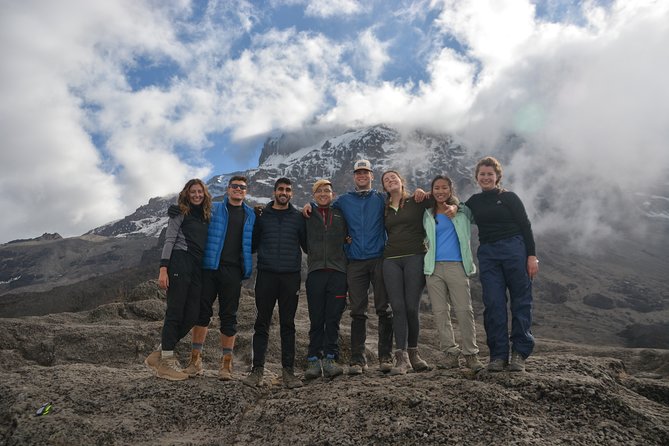
The fourth day is short at about four hours, but it includes a steep climb up grassy slopes. You finish at Mawenzi Tarn Hut, around 4,330 meters, in a cirque directly below Mawenzi’s spires.
This is probably the most dramatic camp setting of the route. You are surrounded by high volcanic rock, open views, and a palpable sense of distance from ordinary life. The camp’s position also gives the day practical value: the afternoon is free for rest or a short exploration to help your body adjust.
That free time matters. Many climbers make the mistake of treating every pause as sightseeing time. Here, a nap, a warm meal, and calm breathing can do more for your summit attempt than extra wandering. Ask your guide what activity is sensible for your condition.
Day 5: Crossing the saddle to Kibo Hut
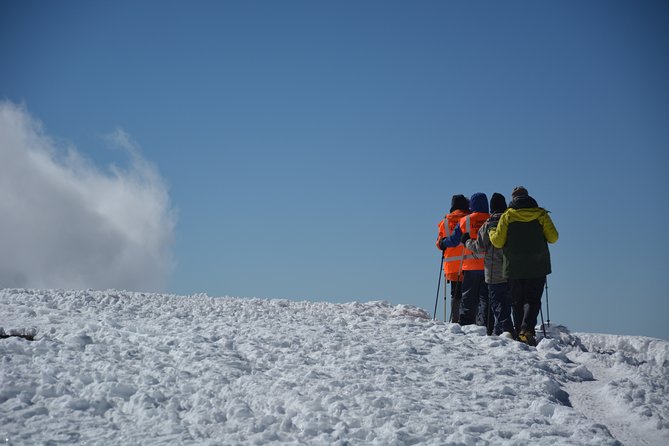
Day five crosses the saddle between Mawenzi and Kibo. The hike takes about five hours, and the setting changes again. The green and grassy tones fade into a broad, barren volcanic area often described as a lunar desert.
You continue to Kibo Hut, where you eat lunch and rest while waiting for the final ascent. This is a quiet but important day. There are no major attractions to chase. Kibo Hut is mainly a staging point for the hardest part of the climb.
You should take the afternoon seriously. Eat what you can, drink as advised by your guide, organize your summit gear, and rest. The midnight start can feel strange because your body expects sleep, not a steep climb in darkness. Your guide sets the pace, and the repeated instruction is simple: walk slowly.
Day 6: Gilman’s Point, Uhuru Peak, and a very long descent
The summit day begins around midnight. The climb to Gilman’s Point takes about five hours and is described as the steepest and most demanding section of the route.
You walk in darkness toward the crater rim at 5,685 meters. The slow pace is not a sign of weakness. It is the correct strategy at this altitude. Your guide should help keep the group together and watch for signs that someone is struggling.
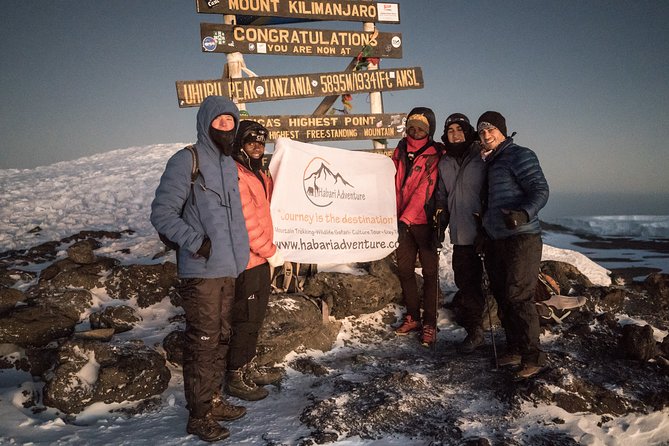
At Gilman’s Point, you get a short rest and a cup of tea while the sun rises over Mawenzi. That view is one of the strongest moments in the entire itinerary. Afterward, you continue for almost another hour to Uhuru Peak, at 5,895 meters, the highest point in Africa.
Near the summit, you pass close to glaciers and ice fields that still occupy much of the summit area. The wording here is important: the mountain has dramatic ice, but you should not assume the scene looks exactly like older photographs. Take your summit pictures, enjoy the achievement, and do not linger longer than your guide recommends.
The day is far from finished after Uhuru Peak. You descend to Kibo Hut for a short rest and hot lunch, then continue down to Horombo Hut at about 3,700 meters. The total day is listed at about 15 hours. That makes this the central physical challenge of the trip, not only because of the summit climb but because you keep walking for hours afterward.
Day 7: Forest descent and the return to Moshi
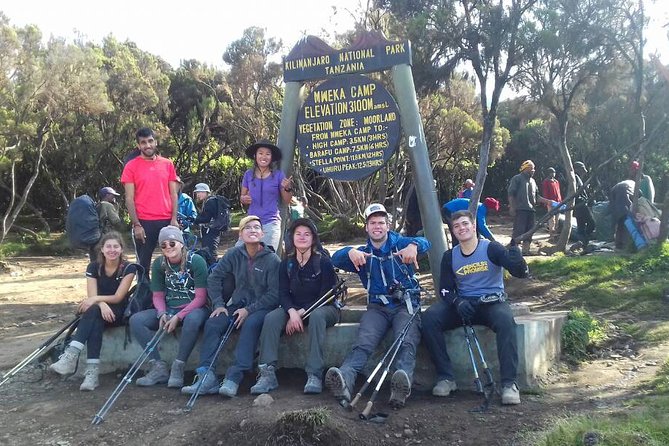
The last day takes about seven hours. You pass through heath and moorland to Mandara Hut at roughly 2,700 meters, where you stop for a hot lunch.
From Mandara, the route continues through tropical forest to the Kilimanjaro National Park Gate. Here you complete park formalities and collect your certificates. A vehicle then takes you back to your hotel in Moshi, where a warm shower and a celebration await.
This final day can feel longer than expected because your legs are tired and the descent puts its own strain on knees and feet. The changing vegetation gives you something to focus on, though, and reaching the gate provides a clear sense of completion.
Guides, group size, and the human side of the climb
Habari Adventure places heavy emphasis on its local guides. The company says its guides come from Kilimanjaro and other parts of Tanzania, with training in safety and first aid. Their stated areas of expertise include local plants and animals, geography, history, archaeology, anthropology, and astronomy.
That range can make a real difference on a long climb. You are not only following someone up a trail. You are spending a week with people who can explain what you are seeing and help you understand the mountain.
Specific guide names connected with strong feedback include Leon, Emmanuel, and Innocent. Leon was praised for making a solo climber feel comfortable during an off-season trip. Emmanuel and Innocent were described as patient, fun, informative, and encouraging, particularly for climbers without much hiking experience.
The group limit is 15 people. That is a reasonable size for a guided climb, though the experience can feel very different with five people than with 15. If you prefer more personal attention, ask about the expected group size and guide-to-climber ratio before booking.
Is $2,840.39 good value?
The listed price is $2,840.39 per person. That is not a casual add-on to a Tanzania holiday. It is a major purchase, so value depends on what you want from the climb and what the price includes.
The strongest value here is support over seven days. You receive a structured route, local guiding, park access as described in the daily program, pickup, and assistance through a difficult summit schedule. The company’s feedback also points to organized operations, friendly staff, good food, and a strong sense of care, including for solo women and less experienced climbers.
I would not book based on price alone. The supplied details do not provide a full list of included equipment, meals, accommodation arrangements, porter support, transfers, or gratuities. Ask for a written inclusion list before making the final payment. Compare that list with other seven-day Rongai offers, not just the headline price.
Free cancellation up to 24 hours before the start time adds useful flexibility. Cancellations inside that window are not refunded, and poor weather may lead to a different date or a full refund. The cut-off follows local Tanzanian time.
Who should choose this climb?
This route suits you if you want a full Kilimanjaro climb with a gradual opening, dramatic Mawenzi views, and a quieter northern approach. It also fits people who value local guides and close support more than a fast or stripped-down ascent.
You should have a moderate fitness level. You do not need to be an expert mountaineer based on the information provided, and the company has supported people with limited hiking experience. Still, the summit day is not moderate. Fifteen hours of walking, darkness, altitude, steep ground, and a long descent require serious preparation.
This is not the right choice if you dislike early starts, shared groups, basic mountain conditions, or long physical days. It is also a poor fit if you want a relaxed sightseeing holiday. Kilimanjaro rewards patience, but it demands effort.
Should you book the Rongai Route with Habari Adventure?
I would shortlist this climb if you want a seven-day route with strong scenery, a gradual start, and a guide-led approach that puts safety and encouragement near the center. The best parts are the quiet forest opening, Mawenzi Tarn, the crossing of the saddle, and sunrise between Gilman’s Point and Uhuru Peak.
Before booking, confirm the exact pickup point, what the $2,840.39 includes, the expected group size, and the names of your assigned guides. If the answers are clear and the summit schedule feels realistic for your fitness, this is a solid choice for a supported Kilimanjaro attempt. If you want a shorter, easier holiday, choose something else.
FAQ
How long is the Kilimanjaro Rongai Route tour?
The climb takes approximately seven days, including the return to Moshi on the final day.
Where does the climb begin?
The climb begins at Nalemoru Gate near the Kenyan border after a drive from Moshi.
What time does the experience start?
The listed start time is 8:00 am. The meeting information refers to Kilimanjaro Airport and Kilimanjaro National Park, so confirm your exact pickup location with Habari Adventure.
How high is Uhuru Peak?
Uhuru Peak is listed at 5,895 meters.
How high is Gilman’s Point?
Gilman’s Point is listed at 5,685 meters on the crater rim.
How long is summit day?
The sixth day takes about 15 hours. You begin around midnight, reach Gilman’s Point, continue to Uhuru Peak, and then descend to Horombo Hut.
What physical fitness level is required?
The experience requires a moderate physical fitness level. The summit day is considerably more demanding than the earlier hiking days.
How many people can join the tour?
The maximum group size is 15 people.
Does the tour offer pickup?
Yes. Pickup is offered, although you should confirm the exact pickup point before the climb.
Can I cancel for a full refund?
You can cancel at least 24 hours before the experience start time for a full refund. Cancellations made less than 24 hours in advance are not refunded. If poor weather cancels the experience, you are offered another date or a full refund.
Just added around Kilimanjaro
- 6 days Machame route climbing Mt.Kilimanjaro★ 5.0 · 8 reviews
- machame route★ 5.0 · 16 reviews
- Mt Kilimanjaro 6 days Marangu route hike★ 5.0 · 3 reviews
- Private Cycle to Kilimanjaro Bike Park Safari★ 5.0 · 6 reviews
- West Kilimanjaro cycling Adventures★ 4.5 · 8 reviews
- Kilimanjaro Climb • Marangu Route ~ 9 Day★ 5.0 · 4 reviews
- 3 Days Private E-Bike Tour in West Kilimanjaro★ 5.0 · 3 reviews
- Kilimanjaro Climb • Machame Route ~ 10 Day★ 5.0 · 6 reviews