
Reviewed · SAFARIS IN LAKE MANYARA
8 Days Safari (Lake Manyara /Tarangire/Serengeti/Ngorongoro)
The biggest draw is the Serengeti migration, with several days set aside for game drives and a possible trip toward the Mara River. You also get a strong sampler of northern Tanzania: Arusha’s forest, Tarangire’s elephants and baobabs, the Ngorongoro Crater, and Lake Manyara’s famous tree-climbing lions.
I like the generous time in the Serengeti, and I like that the route includes a village walk in Mto wa Mbu and a Maasai cultural visit. The main consideration is pace: early breakfasts, long road transfers, basic camping, and several full days in a safari vehicle demand stamina.
Key points at a glance
- Four major parks plus Arusha National Park: The route covers a wide slice of northern Tanzania rather than focusing on one reserve.
- Three full Serengeti days: This gives you a better chance of finding wildlife and migration activity than a quick overnight visit.
- Mara River possibility: July through October offers the best chance of seeing wildebeest in northern Serengeti, though crossings cannot be promised.
- Camping with a safari crew: The package includes a 4 x 4 vehicle, English-speaking guide, meals, water, and campsites.
- Cultural stops add variety: Mto wa Mbu includes a village walk, banana plantations, and local food tasting, while the Maasai boma visit focuses on daily life and traditions.
- Private booking, group-style camping: The activity is described as private for your party, but the camping format is more basic than a lodge safari. Confirm the arrangement before paying.
What this eight-day safari is really like
This is a classic northern Tanzania circuit with an ambitious route. You start near Arusha, head to Tarangire, cross the Ngorongoro area into the Serengeti, spend several days tracking wildlife, then return through Ngorongoro and Lake Manyara.
That route works because each park offers something different. Tarangire is especially good for elephants and baobab trees. The Serengeti gives you open grassland and the best chance of seeing large herds and predators. Ngorongoro packs many animals into a compact crater floor. Lake Manyara adds forest, birds, flamingos, hot springs, and the possibility of lions resting in trees.
You should also understand the rhythm. This is not a relaxed lodge holiday with late breakfasts and short drives. Day 3 includes a long transfer into the Serengeti, Day 4 reaches toward northern Serengeti, and Day 6 combines a morning drive with travel toward Ngorongoro. You will spend many hours in the vehicle, but those hours are part of the safari experience. Rift Valley views, crater scenery, roadside villages, and changing vegetation fill the gaps between wildlife sightings.
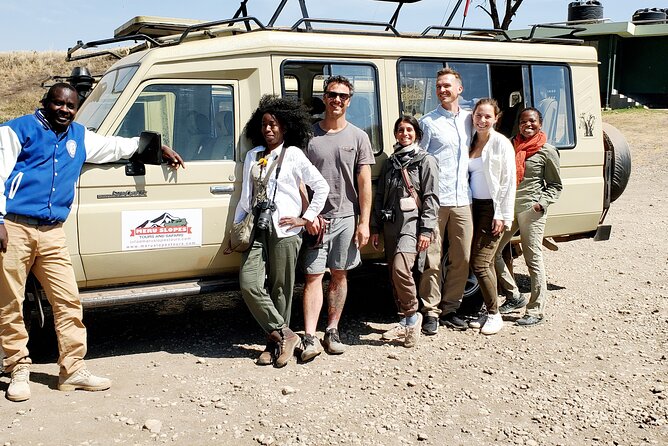
The safari uses an extended 4 x 4 vehicle with a pop-up roof. That roof matters. It gives you a better view while standing or sitting inside the vehicle, and it makes photographing animals easier than through a closed side window. Unlimited drinking water is included, along with a professional English-speaking guide and meals during the trip.
The advertised price is shown as $0 per person, which is almost certainly a placeholder rather than a usable safari fare. Ask for the current total price before booking and confirm exactly what is included. The package says airport transfers, two nights in Arusha, park fees, vehicle, guide, food, and water are covered. Visa costs, personal purchases, drinks, laundry, phone use, and tips are not.
More Safaris in Lake Manyara
- 3 Days Private Safari – manyara, Ngorongoro & Tarangire
★ 5.0 · 94 reviews - Safari in Tanzania 5 days: Manyara, Ngorongoro, Serengeti
★ 5.0 · 29 reviews - 4 Days, 3 Nights Group budget Safari, Lake Manyara, Serengeti, Ngorongoro
★ 5.0 · 18 reviews
Day 1: Arusha National Park and a gentle start
Your first park day begins after breakfast, with an approximate 8 a.m. departure from Arusha. The drive to Arusha National Park takes about 40 minutes, making this the least demanding transfer day of the trip.
Arusha National Park is a good opening act because it is not simply a place to tick off large animals. The entrance route passes through montane forest where blue monkeys are common, and black-and-white colobus monkeys may be seen. Colorful turacos and trogons add interest for anyone who enjoys birds.
The park also contains Ngurdoto Crater, whose steep walls enclose a marshy floor. Buffalo and warthog are among the animals associated with this area. The setting is different from the broad grasslands you will see later, so this day helps you appreciate Tanzania’s range of habitats.
Plan on roughly eight hours in the park. Since the tour begins in Arusha, you avoid a major road transfer on the first day. That is useful after an international flight or a hotel change, though the day still starts early enough to make a proper breakfast important.
Day 2: Tarangire’s elephants and baobab country
Day 2 starts around 8 a.m. with a drive of about three hours to Tarangire National Park. The park is about 115 kilometers from Arusha, and the route takes you into a drier setting marked by large baobabs and the Tarangire River.
The river gives the park its name and draws animals to water. Tarangire is best known for its elephants, and this is one of the strongest stops on the route if elephants are high on your list. You may also look for lions, leopards, pythons that climb trees, and other savanna animals.
The baobabs give the game drive a distinctive feel. You are not looking at the same open grassland scene all day, and the tree shapes make even a quiet stretch of road memorable. The park also offers a good chance to see animals gathered near water, especially in a dry period.
This is described as a full-day game drive, followed by dinner and an overnight stay at Jambo Lodge. The stated duration has a typing error in the supplied schedule, so confirm the exact timing with the operator. The important point is that this is a full safari day after a substantial drive, not a brief afternoon stop.
Days 3 to 6: Four days in and around the Serengeti
The Serengeti receives the most time on this trip, and that is the right choice for a migration-focused safari. On Day 3, you leave after breakfast, load your luggage into the vehicle, and travel toward the park with lunch eaten on the road.
The route offers views of the Rift Valley and Ngorongoro Crater before you reach the Serengeti at roughly 3 p.m. An evening game drive in central Serengeti follows, with sunset viewing before dinner and a night at Seronera campsite.
Central Serengeti is known for broad plains and regular wildlife activity. The open setting can make it easier to scan for animals, while the Seronera area provides a practical base for game drives. Camping inside the park also reduces the need to leave the reserve at the end of the day.
Day 4 is built around a long game drive toward northern Serengeti. The aim is to reach areas where wildebeest movement may be taking place, especially near the Mara River. From July through October, the northern sector is the main focus for possible river-crossing sightings.
Here is the important practical truth: a river crossing is never guaranteed. Wildebeest can gather, turn around, cross at another point, or move back and forth. Even in the strongest months, the timing depends on rain, grazing, herd movement, and the patience of your guide.
Day 5 gives you another full day in the Serengeti. That extra day matters. Wildlife is unpredictable, and a longer stay gives you more time to adjust the route and search for herds, lions, leopards, cheetahs, elephants, giraffes, zebras, and other animals.
The migration calendar changes from year to year. June through September is generally presented as the best period for seeing major herd movement, especially in northern Serengeti from July to September. January through March is the calving period, when the herds are associated with the Ndutu area. Ask the operator where the animals are expected to be when you travel rather than choosing dates based only on a fixed calendar.
Day 6 begins early, around 5:45 a.m., with breakfast and a morning drive through about 11:30 a.m. This is a fine time for wildlife activity and sunrise views, but you will need to be comfortable with pre-dawn starts. After a hot lunch at camp, you pack the vehicle and continue with a game drive toward Ngorongoro.
You spend the night at Simba campsite after dinner. This day combines several activities and can feel long, but it avoids wasting a full day on a direct transfer. I would treat it as one of the more tiring sections of the trip and pack your day bag so you can reach water, sun protection, and warm clothing without unpacking everything.
More Lake Manyara safaris to compare:
- 4 Days Lodge Safari in Lake Manyara, Serengeti & Ngorongoro Crater
★ 5.0 · 18 reviews - 4-Day Manyara Serengeti and Ngorongoro Wonders Budget Safari Tour
★ 5.0 · 11 reviews - 4-Day Safari: Lake Manyara, Serengeti & Ngorongoro
★ 4.5 · 10 reviews - 2 Days Camping Safari, Lake Manyara & Ngorongoro Crater
★ 4.5 · 8 reviews
Day 7: Six hours on the Ngorongoro Crater floor
The Ngorongoro Crater is the most concentrated wildlife stop on the route. You rise around 5:30 a.m., eat breakfast, and descend to the crater floor for a game drive of about six to seven hours.
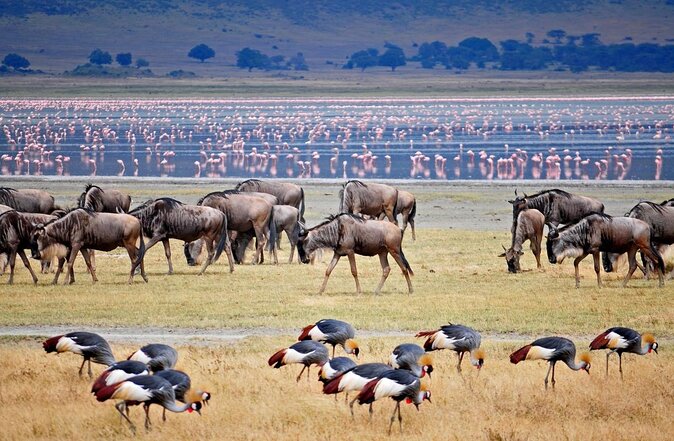
The crater is often called a Garden of Eden because its enclosed setting supports a high concentration of animals. The day may bring sightings of the Big Five, including the black rhino, as well as many bird species. Flamingos may gather in the water, adding color to a day already full of wildlife.
Lunch is eaten inside the crater. That sounds simple, but it is one of the trip’s memorable features: you remain surrounded by the natural setting rather than leaving the park for a restaurant. Follow the guide’s instructions closely during any meal stop, since you are in a wildlife area.
After the crater drive, the route continues to Mto wa Mbu. The village walk introduces banana plantations, local life, and food tasting. This is a useful change of pace after several days centered on animals. It also gives you a chance to see more of the human communities connected to the safari circuit.
The day ends with a drive back to Jambo Lodge for dinner and an overnight stay. After six or seven hours inside the crater and a cultural visit, you may be ready for a quieter evening.
Day 8: Lake Manyara and the trip back to Arusha
The final park day goes to Lake Manyara National Park. After breakfast, you set out for a full-day game drive before returning to Arusha.
Lake Manyara is a compact park with several different attractions. The lake draws flamingos and other birdlife, while the woodland areas are known for the possibility of lions resting in trees. Tree-climbing lions are not an everyday guarantee, but they are one of the park’s signature reasons for visiting.
The schedule also includes a hot spring. You then visit a Maasai boma to see how people live and learn about cultural traditions. As with the Mto wa Mbu visit, this part of the day adds human context to a trip that could otherwise become one long sequence of animal sightings.
The return to Arusha includes dinner and an overnight stay according to the schedule. Since two nights in Arusha are included, one before and one after the safari, confirm whether the final night is at the same accommodation and how the airport transfer is timed.
Camping, food, vehicles, and guide quality
The safari combines camping with some lodge accommodation. The campsites are part of the attraction for people who want to remain close to the parks, but you should not expect the privacy or comfort of a high-end lodge every night.
Food is included throughout the route. The package lists eight breakfasts, eight lunches, and nine dinners, which does not perfectly match an eight-day schedule. Ask the operator to clarify the meal count and whether the final Arusha dinner is included as one of the nine.
Past departures have been led by guides including Jacob, Nuru, Samwel, Benson, Douglas, Mohamed, Iddy, and Jerome Hotti. The company does not promise a particular guide, so request one if you have a preference, but plan on the assigned guide being the person who matters most to your experience.
A good guide can make the difference between simply seeing animals and understanding what you are looking at. The supplied information points to guides who explain flora, fauna, routes, and animal behavior, while cooks prepare three meals a day on some departures. Confirm whether a separate cook is assigned to your vehicle, since that affects the daily camp routine.
The tour is described as private, with only your group participating, yet the wording also refers to joining group camping safaris. That is worth clearing up before booking. Ask whether your vehicle, guide, campsite arrangements, and meals are private, and whether any park activities are shared.
Who should book this safari
I would choose this trip if you want a broad introduction to Tanzania and place high value on the Serengeti. Four days connected to the Serengeti gives you more breathing room than an itinerary that rushes through each park in one night.
It also suits people who want camping, long game drives, and a mix of wildlife and culture. The Mto wa Mbu walk and Maasai boma visit keep the journey from feeling like a vehicle-only holiday.
This is less suitable if you want luxury accommodation, slow mornings, or short daily transfers. It is also not the best choice if your only goal is a guaranteed Mara River crossing. The migration moves on its own schedule, and the operator can only search in the area where the herds are expected.
The tour is marked as suitable for most participants, but the early breakfasts, full-day drives, and uneven safari roads can be tiring. If you have mobility concerns or need a slower pace, discuss that before booking rather than assuming the standard plan can be changed.
Value, timing, and what to confirm before booking
Because the displayed price is $0, you cannot use it to judge value. Get a written quote for your dates and group size. Ask if the quote includes the two Arusha hotel nights, airport transfers in both directions, park fees, camping equipment, meals, water, and the 4 x 4 vehicle.
Also confirm visa costs, tips, drinks, laundry, phone use, and any personal purchases. Tipping the guide and cook is not included, so budget for that separately.
Pickup is offered, and the listed start time is 7:30 a.m., although several daily descriptions say 8 a.m. Confirm your actual pickup time and hotel location. Cancellation is free up to 24 hours before the start time. A cancellation inside that window is not refunded, and poor weather may lead to a new date or full refund.
Should you book it?
Book this safari if you want a full northern Tanzania circuit with the Serengeti at its center, are happy with camping, and can handle early starts and long drives. The strongest features are the extended Serengeti stay, the chance to search for the migration, the variety of parks, and the added village and Maasai visits.
Before paying, get clarity on the real price, private versus shared arrangements, the meal count, campsite standards, assigned guide, and the final Arusha night. If those details suit you, this is a strong value-focused route for seeing several of Tanzania’s best-known wildlife areas in one trip.
FAQ
How long is the safari?
The experience lasts approximately eight days and begins and ends in the Arusha area.
Which national parks are included?
The route includes Arusha National Park, Tarangire National Park, Serengeti National Park, Ngorongoro Crater, and Lake Manyara National Park.
Is the wildebeest migration guaranteed?
No. The schedule offers a chance to follow the migration, including possible Mara River crossings. July through October is presented as the strongest period for northern Serengeti crossings, but herd movements and crossings cannot be guaranteed.
Are airport transfers included?
Yes. Transfers in both directions between the international airport and Arusha are included.
What is not included?
Tanzania visa costs, personal expenses such as laundry, telephone use, and beverages, plus tips and gratuities for the guide and cook, are not included.
Can I cancel for a full refund?
You can cancel for a full refund if you do so at least 24 hours before the experience starts. Cancellations or changes made less than 24 hours before the start time are not accepted for a refund.
More Eight-Day Trips in Lake Manyara
- 8 Days Great Wildebeest Calving Migration Safari from Arusha
★ 5.0 · 254 reviews - 8-Day Small-group Lemosho Kilimanjaro Summit Trekking
★ 5.0 · 186 reviews - Kilimanjaro Climbing Lemosho Route 8 Days.
★ 5.0 · 186 reviews - 8 Day Spectacular Migration Serengeti mid -Range Tanzania Safari
★ 5.0 · 161 reviews
Just added around Lake Manyara
- Wildlife Extravaganza: Manyara, Tarangire & Ngorongoro in 3 Days★ 5.0 · 3 reviews
- 7 Days: Great Migration Mara River Crossing(manyara, Ngorongoro And Serengeti)★ 4.5 · 6 reviews
- 5 days Safari to Lake Manyara, Serengeti and Ngorongoro crater★ 5.0 · 3 reviews
- 4 days Safari Lake Manyara, Ngorongoro crater and Serengeti★ 5.0 · 4 reviews
- 4 Days Lake Manyara National Park, Ngorongoro Crater , Serengeti National Park.★ 4.0 · 4 reviews
- Manyara and Ngorongoro Crater★ 5.0 · 3 reviews
- 2 Days Tanzania Safari – Lake Manyara and Tarangire National Park★ 5.0 · 3 reviews
- Enjoy a Private Day Trip to Lake Manyara National Park.★ 5.0 · 3 reviews
Safaris in Lake Manyara, compared.

Safari in Tanzania 5 days: Manyara, Ngorongoro, Serengeti
Read our review →
3-Day Private Safari to Lake Manyara, Tarangire & Ngorongoro
Read our review →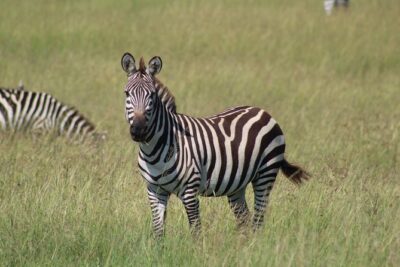
3 Days Safari Tour in Lake Manyara and Ngorngoro
Read our review →Browse the lists this tour appears in